Tuesday, 1 January 2013

Man not in Alora. Four lakes and a bit of tripe

Man Not In Alora. Four Lakes and a Bit of Tripe


If you go down to the roundabout with the Moorish arch on it (The nostalgic Brits call it 'Marble Arch') and carry on up the road you will eventually come to El Chorro.  There is a small village on the other side of the dam. In 2005 the population was 78 but I suspect that the figure is higher now due to its popularity with British settlers. It is part of Álora municipality and you can get there twice a day on the M340 bus. I'm not sure if you can get back. We tend to go by car.  There is a railway station there, a hotel, La Garganta, a campsite, a church, a bar , a hydro-electric plant and a lake which we thought, for a time,  was 'the lakes' which we had read about in the Rough Guide to Andalucía.


                         The El Chorro Dam with the railway station and La Garganta behind

We still  tend to use 'El Chorro' to mean 'The Lakes' although the three much bigger lakes or embalses or pantanos(reservoirs) that you can see from the plane as it approaches Malaga airport.are actually part of Ardales, Teba, Campillos and Antequera and are a few kilometres from El Chorro. To get to them you drive past the dam towards the spectacular limestone gorge el Desfiladero de los Gaitanes or La Garganta del Chorro as it is also called. No matter how many times I've passed this way I always stop to look up the lake at the gorge and the Caminito del Rey that clings to  the cliff.

 
El Desfiladero de los Gaitanes 
 
The Caminito del Rey (The king's little path) was built in 1904 for the workers building the hydroelectric plant to be able to cross between the two waterfalls, El Chorro  and El Gaitanejo  without having to climb down the mountain and back up again.  Alfonso X111 paid a visit there in 1921 to inaugurate the newly built El Chorro reservoir. There is a stone 'seat' by the lake to commemorate the event.  The engineer, Rafael Bejumea was made a count by the king for his work and in 1953 the lake was renamed El Conde de Guadalhorce (the count of Guadalhorce). They say that the king walked on the caminito named after him but I doubt it.
The Caminito del Rey is visited regularly by adventurous and foolhardy people. It has always been  a favourite with the suicidal.
 
 
These days it is in a very bad state and from time to time the Alora authorities announce that restoration will start. There is a big chunk of it missing at its start, just by the railway tunnel which people tell me was removed by the council to avoid the costly recovery of mangled corpses. However, I know that the path there was actually destroyed by Messerschmitt bombers near the end of 'Von Ryan's Express' (1965) starring Frank Sinatra and Trevor Howard.


                                            The Camino del Rey being bombed. (before).


                                                                     And after

Von Ryan's Express was mostly filmed in Italy but for the last scenes Frank Sinatra came to El Chorro and stayed at the Pez Espada Hotel in Torremolinos. Whilst staying there Frankie was arrested after breaking a photographer's camera. Apparently an aspiring  Cuban actress told the press that she was Frankie's lover to gain publicity. Mr. Sinatra was fined 2,500 pesetas and rushed to the airport,  but not before spitting on the floor in front of a photo of Generalisimo Francisco Franco.
The bar in the Hotel Pez Espada where the incident took place is now called 'Frankie's Cafe'.

This film is now very popular
http://www.youtube.com/watch?v=ZmDhRvvs5Xw

This is good too
http://www.adventureworldwide.net/stories/en-el-vientre-de-la-bestia


The Conde de Guadalhorce, the Guadalteba and the Guadalhorce reservoirs supply Málaga and much of the Costa Del Sol with water. There's no public transport to The Lakes.


                                                    El Conde de Guadalhorce (built1921)
 
If you manage to get there you can swim, fish,  paddle a canoe or even pedal a pedalo on the Conde de Guadalhorce and there are bars and restaurants which fill up at weekends. It's a popular spot. Maureen broke her leg going down to the lake for a swim, so watch your step. Have a coffee in the Posada del Conde instead. The camarero is called Juan. He thinks Álora people are brutos (rough, stupid, ignorant or uncouth).
 
We take Tommy for long walks near the  El Mirador bar/restaurant. You can walk for miles without meeting anybody else. In February you can see these little wild daffodils which I think are called Hoop Petticoat Daffodils or Campanillas Chicas and in March, Bee Orchids.
 
Campanillas Chicas
 
 
                                                            Bee Orchid (Orquídea Abeja)

El Mirador is mostly an open air restaurant and gets mixed reviews from people I know who have been. The chips are always OK. We went once in the winter and had to fight for a table inside near the open fire. I had Migas which means 'breadcrumbs'. I was a bit put out when that was exactly what it was. I've never ordered it again anywhere. It seems to be on every menu and lurks there to trap an innocent adventurer; quite the opposite of Callos which means 'tripe' but is full of stuff like chorizo, morcilla, pigs' feet, tripe  and chick peas (garbanzos). A porky delight. Don't order it in Bilbao though. It really is only tripe. (unless you are really fond of tripe).

01/01/2012


Monday, 17 December 2012

It's a wise child that knows its own father

It's a Wise Child That Knows It's Own Father


I have been 'Man Not In Álora' for three weeks now  and I'm starting to miss the place a lot so I've had a look at the website of the ayuntamiento (town hall) to see what's been going on in my absence.
http://www.alora.es/Inicio/Default.asp

It's good to go through the photos and pick  out familiar faces. 'Look,  there's Mario. What's he doing there?' 'I didn't know Pablo had anything to do with the town council.' and so on.
The main headline today is:

"About 400 schoolchildren take part in the 'Pepe Rosas' Villancicos meeting. "


This is the eighth annual Christmas event where the schools get together to sing traditional Christmas songs (villancicos)  in honour of  Pepe Rosas the local folklorist and expert on Verdiales music and dancing who died in 2008. There is a street in Álora named after him, Calle Folclorico Pepe Rosas.

 
                                                                   Pepe Rosas
I have just found this short film about him on YouTube. Some of the footage is quite old and shows Pepe and Alora in the 50s or 60s. It also shows children singing villancicos and verdiales dancing.

http://www.youtube.com/watch?feature=endscreen&v=7WH7XY6urGA&NR=1

Here's another shorter film;

http://www.youtube.com/watch?v=CkfOZXsaCkI

Pepe lost his sight a few years before his death.

I was introduced to him  in 2000 by Conchi Vila who was a close friend of Pepe and had a shop on the corner of  Paseo Martos. Pepe spent a lot of time sitting in Conchi's shop, which sold upmarket Moroccan stuff. In earlier years Pepe would go to Morocco to buy items for the shop. He always wore a flat cap and in winter a Burberry scarf; the same one he is wearing in the shorter film. Pepe spoke no English but had visited many countries including the USA and Japan in the 60s and 70s presenting the Verdiales of Alora to the world.

 He was always ready for a chat. I can't say that I understood it all but he would clutch my arm in Conchi's shop, and speak,  in a conspiratorial tone, about the years  of the Franco dictatorship. He once told me that he had been very friendly with one of the putas of the town. He used to sit with her in Cafe Central in  La Plaza de la Fuente Arriba watching the comings and goings in the square. She would point out this or that businessman, politician or policeman and describe his sexual preferences, performance and physical endowment.

He once told me that the street where I live, Calle de Benito Suarez (formally Calle Bermejo) used to be called 'la calle de los curas' because, being adjacent to the parroquia (parish church),  several priests lived in the houses, including ours. My Spanish was not good enough to make out all the clearly scandalous story he told me about our house but I'm sure it included a baby.
He was always adamant that he would not write down any of his stories; they were too dangerous. What a shame. What a loss.

Pepe's real name was José Rosas Hidalgo. I've only just found this out. I knew he was called José (Joseph) because all Josés get called Pepe  (pronounced 'peppy') or Joselito or Pepín and Josefinas are called Pepa or Pepita (little Pepa).
These are examples of the diminutives and apócopes used for names in Spain. Some are just abbreviations but others are more interesting.

Most of the men I know in Álora are called Pepe, Paco or Antonio with a fair number of Juans, Pedros and Diegos ; all saints' names. Often a surname, apodo or another distinguishing name is  added to prevent confusion , eg.

Paco Gordo...Fat Paco
Antonio Motosierra.....Antonio with the chainsaw business
Juan Alto......Tall Juan
Pepín.....Little Pepe


José Sánchez MorenoApparently José becomes Pepe because Pepe sounds like P.P. (PePe) which can stand for 'padre putativo' or 'presumed father' when there are doubts about the identity of the father of a child. This was the case with Jesus and so Joseph was the PP, so Pepe.

Our alcalde (mayor) is called
José Sánchez Moreno but everyone (except me) calls him 'Epi'. I don't know why.


Franciscos are usually called Paco. I don't know why this is  either. A lot of Pacos prefer to be called Francisco, like Francisco Franco and Francisco who works in the planning department on Calle Negrillos.

Maria is far and away the most popular girl´s name in Alora  so many Marias have a second name which is compressed into an apócope.

Here are a few feminine apócopes;

Marilena.......Maria Helena
Maribel..........Maria Isabel
Maripepa........Maria Francisca
Marilu...........Maria Luisa 
Mafe.................Maria Fernanda
Mayte.................Maria Teresa

and so on. I may have made a couple of these up.

Here's a few more:

Meche.........Mercedes
Conchi/Cuca.......Concepción
Dori.........................Adoración
Inma..............................Inmaculada
Puri.....................................Purificación

Some masculine names are contracted in the same way.

King Juan Carlos 1st. becomes . Juancar but I wouldn't address him as such if you ever meet him.

17/12/2012

Tuesday, 11 December 2012

Olives

 
Olives
 
 
Olea Europaea
 
Paddy came round on Sunday and we discussed bottles. We are now serious olive oil producers and need some bottles. This is the first year that we have produced enough oil to have our own pressing and it deserves to be bottled. We have decided to call it Finca Caicune after the area where the the trees are. We have about a hundred trees near the town of Casarabonela which is 12 miles from Álora. We picked 1027 kilos this year , about a ton, which is more than twice as much as last year. (Total Spanish production last year was 1.59 million tons. Olive Oil  Times. http://www.oliveoiltimes.com/olive-oil-business/spanish-olive-oil-harvest-sets-record/26303
From this amount we have 108 litres of oil. It takes about 5 to 6 kilos of olives to produce a litre of oil, depending on the variety of olive so that's a bit low.
                                                                      Olive Oyl

 
Mo and I picked 415kg. and Paddy and Laura picked 612kg. This has to be said because Paddy will read this. It also has to be said that they picked the best trees and we were working in very muddy conditions.


                                     Mo's Muddy Boots

Our trees are about 12 years old and so are babies. They should reach full production in another twenty or thirty years but we probably  won't be hanging around to see that. A mature tree in good condition should produce 20 to 60 kg. We got 40kg. from some of our trees this year: not bad.
Olive trees can carry on producing olives for hundreds of years and can be regenerated by cutting the trunk right down. New shoots will appear and will grow into good trees. There are olive trees around which are more than 2000 years old. Old olive trees are very valuable and can be moved without much harm. There is one in the centre of Álora which is at least 600 years old. It has been moved twice in the last ten years and is producing olives.

                                         
                                               600 year old olive tree with local talent
                                                           
If you have an olive tree more than 800 years old you could get 2100 €  for it. One more than 2000 years old would cost 9000€ plus postage and packing.

Interesting Olive  Fact (IOF)  All olives start off light green, then go dark green, then purple/black. Black olives are mature olives and contain more oil than green olives so it makes sense to pick the olives when they are black if you want oil. Eating olives are usually picked green as the flesh is firmer.

Finca Caicune is a fanega which is approximately 6500 square metres and we bought it from  Forbes and Mary who were hoping to build a house there. They fell foul of the planning laws, in particular the 'Ley del Suelo' of 2002 which prohibited house construction in the countryside; sadly a familiar story in this part of the world although thousands of houses were built round here and are  'illegal houses', many of which are threatened with demolition.
Our  trees had been neglected for  several years so needed heavy pruning, fertilisation and weed control. The weeds have been the biggest problem. Apart from robbing the ground of nutrients and water, they are a fire risk if left and the Guardia Civil can slap a fine on you. We have tried horses and sheep. The horses damaged the trees and the sheep ate the leaves (they can reach surprisingly high).
The views are fantastic and we  often see an eagle circling. We could see the sea if it wasn't for the mountains in between.

                                                            View from Finca Caicune

                             
                                                         The sheep with shepherdess

                          
                                                                   Finca Caicune


11/12/2012

Monday, 26 November 2012

In transit Gloria Swanson

In Transit Gloria Swanson

Back in Birmingham for 3 months so only a few 'Man not in Alora' posts for the time being.

 
The drive to Bilbao or Santander  on the Autoroute del Sur (to Madrid) and the Autoroute del Norte (From Madrid) is never boring. It takes about 6 hours to reach the Madrid periphery, an hour to  get tangled up and then untangled  in the ring road system and then, after an overnight stop in Aranda de Duero, another three hours or so to reach the port of Santander or Bilbao. This time we brought back back lemons, oranges, olives, olive oil, salchichón (salami) , morcilla de Burgos, morcilla de Asturias (black pudding) chorizo (normal and from Asturias), 40 bottles of wine, one bottle of Larios gin, dates, turrón (big slabs of chocolate , marzipan, praline and more), pancetta, a jamón serrano bone,  4 bags of sea salt, paella rice, two bikes, our dog and some luggage.
 We're driving home for Christmas.

Usually we set off early and drive for an hour or so before looking for somewhere for breakfast. Finding a suitable place is crucial. We want a busy cafetería that can give us good coffee and tostadas with garlic and  olive oil (and tomato for me). We have made mistakes in the past and  put up with petrol stations with a coffee machine or 'modern' places like 'Autogrill' with the oil in sachets and more than once  we have been misled by signs promising coffee, food etc and have been led miles off the road to a semi derelict venta run by a truculent ex Franco assassin . We have developed a rule of thumb with the help of Mike Newton's book (still available I believe. Ask me for a copy) which is: 'If you can't actually see the place,  don't take the exit'. Always look out for the crossed knife and fork sign and if possible a big 'H' for hotel, for these are the places where you will find Spanish travellers tucking into a breakfast tapa or tostada with red lard and a coffee and anis. The noise is often deafening, the TV banging out the news, the cups and plates rattling away and the camareros shouting orders. Fantastic.

One of our favourite stops north of Burgos is Hotel Sotopalacios in the hamlet of Sotopalacios which ticks all the boxes and has the added advantage of being next door to a black pudding factory and shop where they sell the best Burgos black pudding (made with rice) there is and will open even during 'siesta' if you ring the bell. Hotel Sotopalacios holds other fond memories. In 2001, travelling with friends Terry and Moira, we stayed the night there (black pudding for breakfast). Our room was very unusual. The bathroom had a jacuzzi and various showers. The bedroom had a big four poster bed with an array of light switches which controlled the 'images' on the ceiling of the four poster. I remember a mirror which changed at the flick of a switch to a 'romantic' scene of two lovers 'desenfrenado'. Terry and Moira's room had similar bathroom fittings and bed, but not one other piece of furniture.

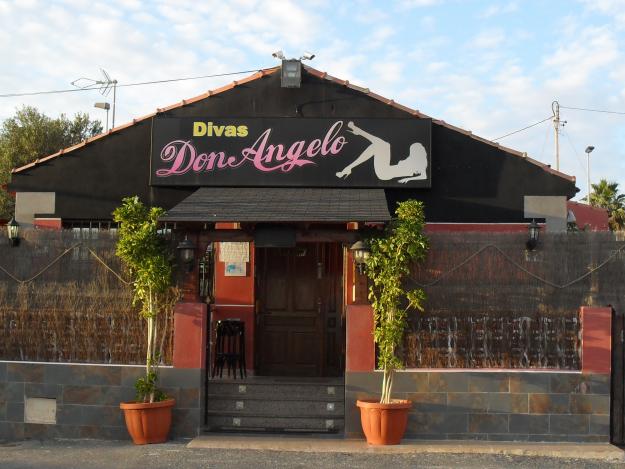
This reminds me of the fact that the autonomous region of Castilla La Mancha holds 80% of  Spain's 'clubs de alterne' or 'whiskerías'(knocking shops). These establishments, which are entirely legal, are seen frequently along Spain's roads and can be identified by neon signs, reclining female figures and interesting names, like 'Venus', 'Rosa' and 'Oasis'. You can learn more about them, how to find them, reviews and  prices at www.alterning.es 


 Alora's is called 'Laurel' and is on the Malaga road. It carries the sign 'Para que te sientas bien' (so that you feel good). Some Brit linguists have translated this (missing the subjunctive) as 'So that you sit well' which has resulted in much speculation about the intended meaning.
We passed through a small town in Castilla La Mancha which had three of these 'puti clubs' alongside the main road to Madrid. The town is called 'Consolación' (pop. 223) !!

Another familiar sight on many Spanish roads is the Osborne bull.

These black 14 metre high well endowed  bulls are found nearly everywhere in Spain and have become a national symbol (that is, they are used as car stickers, t shirts etc.). They are really advertising hoardings for Osborne brandy.  They were originally erected by the Andalusian company in 1956 and had the name 'Osborne', 'Veterano' or 'Magno' written across them.

 
They were made of wood which rotted so in 1962 were replaced by the steel structures seen dominating hilltops along the autovias today . At that time there were 500 bulls in place.  Now there are 89 with only two having the Osborne name on them. We saw about ten on the way up to Bilbao.


A move in 1994 by the government to remove them because they were considered a hazard to driving was met with national protests. They bulls were allowed to stay but the company's name had to be removed.
Not all of Spain welcomed the Osborne Bull. The Basques and Catalans saw it as a symbol of oppression and many were pulled down. They now have one each. The Basques replaced some of them with 'basque sheep'.
The artist who created the bull, Manolo Prieto was a militant communist so it is ironic that this image is now used as as symbol of  'Spanishness' and flags bearing the image are waved at football matches and right wing demonstrations.

Stop press.........Paddy has just called from Alora. This year we have bagged 1027 kilos of olives which will give us 100 litres of oil. Orders welcome.

26/11/2012


Saturday, 24 November 2012

The Vuelta

The Vuelta


Yesterday we did a 'vuelta'; the first for some time. A vuelta involves visiting a number of favourite bars for a drink and a tapa or two. All the bars on the route are in or near the top square (La Plaza de la Fuente Arriba) and will be featured at some point in the popular series 'Favourite Bars'. 'Vuelta' or 'dar una vuelta' means to go around as in 'dar la vuelta al mundo' (to go around the world) or it can mean to go for a walk. Or it can mean 'a pub crawl'.  Our vueltas began twelve years ago. Our leader was Antonio Martos and on Wednesdays he shut his bar and did the rounds of the competition. Terry and I were invited to join him (and later Chris and many others) to be introduced to the popular art of 'tapeando'.

Here's the routine.
 
 
Bar Alegría
 
We walk into Alegría at midday. Antonio is already standing at the bar with a caña and a tapita (a small tapa).  Pedro looks up and holds up two or more fingers and we nod. Two more cañas. 'Tapa?' 'Qué tienes?'
Pedro recites the list of hot tapas and indicates the cold ones on the bar, 'Rosada, calamares gambas plancha, boquerones, coquinas, magro, huevos cordoniz...........'
'Dos Huevos Cordoniz'. Mini full English Breakfast! A fried quail's egg and a piece of bacon on a small piece of 'pan cateto' (a dense bread). And off we go. By the time we have finished the tapas and had a few sips of the ice cold Cruzcampo,  Antonio has paid the bill and is heading for the door having left an inch of cerveza in his glass. We gulp down the beer and follow.
Variations on this procedure then take place at Bar Madrugon, Cafe Central (known as Salvador to the locals), Los Caballos Dos, (no Bar Chismo as, except on glorious rare occasions, it used to shut on Wednesday's), The Peña Barçelonista (until it closed down) and then on for the grand finale at Lod Antonio. I'm sure I've left one or two  out. Oh yes, and Antonio would sometimes backtrack to Alegría or have two drinks and tapas at Azahar which would throw out our calculations on whose round it was. This element was difficult enough as it is not unusual for the round to be paid by an apparent stranger who gives the camarero a secret nod and leaves without a word. For this reason we always keep a five  or ten euro note in our hands, ready to slap it on the bar if Antonio or anyone else gave the slightest sign of leaving or paying .
A few years ago, when times were better we'd meet other groups or individuals tapeando, especially after 2pm. during the lunch break. These days Wednesdays are pretty quiet around the bars.
The Vuelta has been a great opportunity for practising our Spanish and meeting Perotes.(come to think of it, it's the main reason for learning Spanish anyway).  Names, phone numbers, names of recommended books, bands , authors etc. are scribbled down on paper serviettes from the bar and found (or washed) at a later date in pockets. 'Now what was that about?'
We have never got to the bottom of why Antonio and other Perotes leave a small amount of beer or wine in their glasses. Perhaps it's a tip for the camarero although I doubt it. It seems a bit of a waste to me, as does their lack of concern that their glasses are not filled to the brim; indeed there is a `preference for as much espuma (froth) as possible. When I told the old joke of the man asking the barman 'Can you put a whisky in that?' ('Well if you can fit a whisky in you can fit some more beer in') it brought the house down. Then I realised that it was only being taken as further proof that foreigners are cheapskates. I had to repeat it in every bar. How we laughed!
 
Antonio Martos in his favourite spot in Lod Antonio
 
The last port of call for many years has been the bar Lod Antonio which many people still call Bar La Rampa owing to the signs outside with that name on them. Lod Antonio has a fantastic cook and a list of tapas on a blackboard which makes your eyes water (so does the cook). Lod Antonio will feature soon in the popular series, 'Favourite Bars.'
Lod Antonio is strategically situated two doors down from Antonio's bar/house and here we would part company with him  and he would go home for his lunch (!), but not before 'la penultima' (the next to the last drink) and la espuela (the last drink to 'spur' you on your way home). You never say la ultima' . That means your very last drink.
By this time we are usually well into the Vuelta and, not wishing to end the fun we have been known to continue our progress, sometimes discovering 'new' venues.

24/11/2012

Thursday, 8 November 2012

Cafe-Bar El Madrugon

 
Rain is forecast for all this week and it's only Wednesday. La Plaza de la Fuente Arriba (Top Square) is busy for a couple of hours in the morning but by 1.00pm. the only activity is in the bars. The chairs and tables on front of 'La Alegría'  'Los Caballos Dos' and 'Bar Madrugon' have disappeared. Even 'El Bulgaro' isn't putting his out in this weather.

It's time for the second in the series 'Favouite Bars'. Today it's 'Cafe'Bar El Madrugon'.
I'd never noticed the 'Cafe' part before. Madrugon is probably the smallest bar in Álora and is as small as it looks here. It is run by Manolo and his son Javier You could fit about seven men around the bar and perhaps another three behind them (unless one of them is 'Paco Gordo' who runs the bar nearly next door.) I wrote 'men' because most women give it a miss.
´El Madrugon´means 'the crack of dawn' and Manolo opens every day at 5.30am. , which is two hours before daybreak at the moment,  until 2pm. and opens again at 4.00pm. until trade dries up. . I have only been there once before 7.00am. In the good old days of the construction boom El Madrugon would be crammed with men having a coffee and brandy or anis or two before meeting their lift to the hazardous building  sites on the coast.
Manolo usually stands in the doorway of his bar and always greets me with a 'Holá. Qué hay!' in his growly voice. Apart from this greeting I don't understand much of his conversation. I smile and nod and make the odd guess at what he's talking about and order a mitad doble (cafe con leche) or a caña (small beer) (Cruzcampo).  Javier speaks more clearly but faster and with a lot of shrugs and gesticulation. Manololo calls him Él niño' and Javier calls him ' El Moro' (the moor) but not to his face. El Moro has been Manolo's apodo (nickname) since he was a boy and had a dark complexion. You can see this in one of the old football team photos on the wall. His name actually appears on some of these photos as 'El Moro'. He also makes an appearance in the film 'Children of Alora' which was made in 1964 and is well worth a look. Manolo is in the crowd watching a ´Verdiales'  performance near the end of the film. http://www.youtube.com/watch?v=5CZCzSS9tHE He is standing between the two guitarists

That's Javier behind the bar and Manolo is sitting on the stool behind Paco 'Gordo'.
 
Like all the bars here (I think) Madrugan has a selection of tapas. Manolo's speciality is ´Caldito' which is hot spicy fish soup served in one of those glass cups that they used to serve 'frothy coffee' in during the 60s. At the bottom of the glass is a piece of fish. Try it. Manolo used to serve riñones al Jerez (kidneys in sherry), carrilla (pig's cheek) and other hot and tasty tapas but the Public Health Inspector stopped him doing them as he hasn't got a kitchen. He used to cook them at home and warm them up on a camping  gas stove at the back of the bar. His tapas now are mainly cold except for chorizo al infierno (literally chorizo from hell) which is a chorizo cooked in a pig shaped pot with a solid fuel tablet. Manolo recently asked me to do an English translation of his tapas list which is now displayed on the bar. Among them you can find  'chorizo from hen'.

José Luis Rodridgo Zapatero visited Álora during his term as Spanish prime minister. Manolo was a big fan and sent him this picture I took on the day.

 
He has a framed letter from Zapatero on the wall thanking him for the photo.
 
During the warm months Manolo has tables and chairs outside the bar. He shares them with Paco at La Alegría. Paco provides hot tapas too. They have proved very popular indeed and must have doubled Manolo's profits.


Monday, 5 November 2012

Another Monday morning


Ghouls and Gas Bottles


It's Halloween here ín Álora too. Most of the young children went to school dressed as witches, demons, monsters and ghouls and tonight some of them will be ringing our bell. I've bought a bag of 'Halloween Truco Trato' caramelos (sweets) from Mercadona. I hope they don't expect cash.

Tomorrow is El Día de los Santos' (All Saints) which is very important here. Families go up to the cemetery with flowers to visit the niches of their dead relatives and then have a bit of a do afterwards. Many will be eating huesos de los santos (saints' bones) which were on sale at the bread shop today. El Dia de los Santos is a national holiday so the shops will be shut.
Trick or Treating is an imported thing as it is in the UK. Eloisa at the library asked me what it was all about. I don't really know. 'Truco Trato' is a mistranslation too . 'Un trato looks a bit like 'treat' but it means 'a deal'. 'Un gusto' would be closer. That is unless you take to 'treat' to mean to 'deal with' (as in 'treaty') and then it's all OK.
This is our neighbour. He's a Real Madrid supporter...

It's getting colder now and I had to change our first bombona (gas bottle) for months. We have no mains gas supply here, only the big cities do, so in the winter it is a common sight to see people lugging these big orange gas bottles around on their shoulders or on little trolleys. You can exchange bombonas at garages and some shops but most people in town wait for the the Repsol lorry's weekly delivery (Wednesday afternoon on our street and make sure you have the right change!). Bottled gas is cheaper here than in the UK (16€ at the moment).
Periodically we get a letter telling us to arrange an inspection of our gas appliances. This usually costs between 50€ and 150€ and as there have been numerous bogus companies doing 'inspections' most locals ignore the letters, tell the 'tecnicos' to clear off and renew their own tubing. I went to the Repsol office in the Plaza de la Fuente Arriba to buy some official (dated) tubing this morning. The office is tastefully decorated with original oil paintings.
We had three trick or treat visits but lots of caramelos left for me.
31/10/2012


Another Monday Morning


María José who is in charge of the Museo Municipal de Álora is very excited about a special exhibition at the museum. It is about El día de Santos and a history of burials in Álora.The museo is at the bottom of our street next to the 'Iglesia Parroquial Nuestra Señora de la Encarnatión' (the parish church). I am interested in funerals at the moment anyway but she promised that we could go up the belltower too. (A very rare treat, apparently). We turned up with some friends and a couple of young perotes (Áloreneans) at midday and a smiling  María José gave us a tour of the exhibition. The building  is old  (16th. century) and looks like an old crypt and was  actually part of the site of the second town cemetery. They found lots of old  bones and bits of a candelabra when they were digging it out to make the museum seven or eight years ago.. The exhibition consisted of the bits of candelabra, some gravestones or nicho (niche) ends, a coffin on a stand covered with a dark purple cloth and a couple of information panels. It was atmospherically lit.
The old graveyard  was transferred  up Calle Ancha to the castle in about 1820 and remained there until it was full in about 1998  It is now on the hillside opposite our back wall .
It says on the information panel that the bodies were carried up to the castle on 'lomo de burro' a donkey's back. 'Lomo de burro' is also one of the many names for a speed hump. Calle Ancha means 'Broad Street', which it is not. My friend Antonio told me it got its name because of the large number of corpses which have had to carried up there.

We climbed the spiral steps up to the belfry just before 1.00pm. (4 clangs followed by 1 more). Safety measures have not yet been installed (and no ear protectors).  Both bells have at thick coating of pigeon shit which dulls the tone a little.

I was anxious to get up into town to buy some pigs feet and a tail before the carnicería shut at 2.00pm. They had none on Friday as it's 'callos' season now. Soups and stews are in vogue now that the weather has turned cooler and callos is my favourite

Ingredients for Callos

Callos (tripe)
Pig's feet
Pig's tail
Pig's ear
Pig's tongue
Pig's ear
Chick Peas
Chorizo
Morcilla (black pudding)
Onion
Tomato
Garlic
Paprika
Parsley
Bay leaf
Cloves
Nutmeg
Cumin
Black Pepper (ground)
Water
Salt
Añejo (Idon't know what this is but it looks like a piece dried  salty pig skin)

I called in at Bar Madrugon (see next post) where Pepe Rojas was having a beer. I proudly showed him my bag of goodies.'For a callos' I said. 'look at this then'. says he. In a bag he had about ten pale oval objects.
´Huevos de oveja' Sheep's testicles.

05/11/2012