Tuesday, 10 November 2015

. A Hundred ways with Olive Oyl. Pressing business for Sánchez.


A Hundred Ways with Olive Oyl.


                                           A Short Toed or 'Snake' Eagle

It's olive picking time. The Sánchez Olive Oil Empire's hardy and willing workforce is about to swing into action again. We're off to  Casarabonela, in the heart of La Sierra de las Nieves in the Biosphere Nature Park and just a stone's throw from Álora. (24km/15 miles). That's where the family estate is and its 100 olive trees. 


                                Finca Vanamba/ Finca Caicunes/ Olivar Caicunes
 
We've been rained off for a few days so far but we hope to start again tomorrow. (we did). Mrs.Sanchez uses the occasion to show off some of her favourite designer workwear and we all look forward to her latest ensembles. Local farmers and goatherds alike stand and gaze as she strives in style beneath the leafy boughs.  Passing motorists travelling between Casarabonela (just try saying it!) and Ronda sound their horns and have been known to miss completely the dangerous bend, just out of the picture on the left, with tragic results.

                                   Mrs Sánchez wearing this season's olive outfit

It's a sight for sore eyes if ever there was one and I can testify to that because I was struck in the eye by a springy olive twig on Sunday and it hurts. I have bought some safety spectacles from our local ferretería in Álora. They are selling like hot pies there at the moment..

A lot of people think that olives are either green or black but we've got green ones, black ones, yellow ones and purple ones and some that are yellow AND purple. They all go black eventually, when they are ripe. All our olives will go to make oil and the best time to pick them is when they are ripe (black).

Q: What do you call a woman who collects olives?
A: Annette.

That's an olive growers' joke. I bet you were going to say 'Mrs. Sánchez'!  We olive growers split our sides every time we hear that one, I can tell you.
  
Anyway, that's how you pick olives. You spread a net or two under the tree and try to make the olives fall on to the net. Most olive pickers round here hit the branches  with a long stick  and hope the olives will all fall onto the net. It's called 'vareando'.


Apart from the obvious health and safety issues that arise when two or more beefy bough bashers  thrash about in the air with big sticks, ( I can just hear my mum saying 'Stop that right now.You'll have someone's eye out!'), we think that it's cruel to the trees and anyway  our olives don't respond to rough treament and would refuse to fall into the nets. The nets are called either mantos or toldos depending on who you speak to in Cafe-Bar El Madrugón but never redes which is the Spanish word for nets.

Álora's most popular olive is called a Manzanilla or aceituna Áloreña.. It has DOP (denominación de origin protegida) status like Melton Mowbray pork pies. Manzanilla means 'little apple' and that's what it looks like. It's one of the best olives in the world for eating. 

The oil is good, too, but a little bland.


Manzanilla Olives

 Our olives are 'Picual' and are grown just for the high quality oil they produce.

 
   We've picked 750 kilos so far which should give us at least 75 litres of Extra Virgin Oil. And we're not halfway through the crop  yet.


Picual Olives

We'll take the olives to the mill just over the hill from our olivar  (olive grove) to be 'pressed'. Before any olives are pressed they have to be ground (molido) or 'milled'. Olive oil is the only edible vegetable oil that is produced from the flesh of the fruit, but the stone is also crushed along with the flesh for it's oil content. It is the pulp made from the skin, flesh and stone of the olive that is 'pressed'. Traditionally this was done between circular straw mats.

                                                            An Olive Press.
 
To be 'Extra Virgin Olive Oil' the oil must have an oleic acid level of no more than 0.8%. Anything above this will be plain old 'Virgin', lowly 'Olive Oil' or one of the nastier 'refined' olive oils which has goodness knows what unspeakable things done to it.

Spain is the biggest producer of olive oil in the world. Much of its oil goes to Italy where it is relabled and sold as Extra Virgin Italian Oil and exported to the USA where the Mafia control the whole bang shoot. (Just watch The Godfather 2 if you don't believe me).


This year Sanchez Oil Empire SA. expects a bumper crop so we have been obliged to employ some cheap foreign labour. The wage levels are poor so it's difficult to attract good quality workers. An ability to multi-task is essential in this job. Here you can see one of our casual staff doubling as a telegraph pole.


 I'll let you know when our oil is ready for sale. I suggest that you get your orders in quickly while stocks last. 
On the way to Finca Vanamba/Finca Caicunes/ Olivar Caicunes the other day we spotted a Short-toed Eagle flying with a snake dangling from it's beak, a bit like the one in the photo above.

Speaking of pies, you may remember I have been looking for a decent Spanish pie. Most unexpectedly I saw this sign outside a bar in Córdoba a couple of weeks ago.


Third on the list; 'Empanadillas de Cochinillo' (little suckling pig pies'). Unfortunately I wasn't able to sample one of the little chaps but it looks like Spain is getting on the right track at last.

I had a 'pork and chorizo pie' in a pub in Liverpool a few months ago which sounded like a simple but brave attempt (for Liverpool) at  feasible fusion food. It was the worst pie I have ever encountered. It must have been in the pie display cabinet since the Beatles used to drink and eat pies in there with rocking horse people. I told the barman it was as dry as a dead dingo's donger and he  helpfully suggested that I should try tomato sauce on it or f*ck off. How we laughed! I should have had the 'Scouse pie' instead.
Incidentally, if you are in Liverpool and partial to a bit of top class authentic Spanish nosh (with a dash of scouse) get down to 'Lunya' in College Lane. They even have Tomatoes in Olive  Oil from Álora.


November 10th. 2015


Saturday, 10 October 2015

Two Virgins, Free Bread and Water and Dog Psychology.

Two Virgins, Free Bread and Water and Dog Psychology


                                                     Nuestra Señora del Pilar

There are so many fiestas in Spain that there aren't enough days in the year to fit them all in. That's why this weekend is a puente( bridge/long holiday, Friday till Monday)  so that they can celebrate:

La Fiesta National de España (The National Day of Spain)
El Día de la Hispanidad (The Day of the Hispanic Community in the World)
El Día de las Fuerzas Armadas (The Day of the Armed Forces)
El Día de Cristobal Colón (Christopher Columbus Day)
El Día de la Guardia Civil (The Day of the Guardia Civil)
El Día de Nuestra Señora del Pilar (The Day of the Virgin of the Pillar)

They all happen on October 12th., but to be fair, we don't do Columbus Day any more in Spain because it has unpopular colonial connotations, the Guardia Civil are an armed force and the Virgin of the Pillar is the Guardia Civil's patron virgin. 
The Guardia all over Spain will have big parties with lots of food and drink on Monday  so there's no chance of being pulled in by them on some trumped up charge and fined 200€ (like I was) on Monday.

Pilar is a very popular name for girls in Spain. There was one in 'For Whom the Bell Tolls' by Gary Cooper. I know at least one. I had no idea that she always stands on a pillar until I looked for a picture. We don't have one in Álora (yet) although we do have a Jesus Attached to a Column

Regular readers may have noticed that, along with pies (see previous posts), virgins get more than their fair share of mentions in this organ. And not without reason. Apart from there being a lot of them about I have found that the readership of this humble organ doubles when I put 'Virgin' in the title. I think Google has something to do with it.

Speaking of pies, imagine my excitement when I saw this in today's 'SUR' 


'The flavour of pies of the Sierra Gibralmora' it appears to say,  but ..NO!. A false friend indeed. 'Los pies' translates as 'the feet'- nothing to do with pies at all, even though it's clearly an article about food. 'Flavour at the feet of the Sierra de Gibralmora'. It's about  the Ruta de las Tapas in Pizarra this weekend.
A bit of a disappointment but at least that's Sunday's itinerary  sorted. 


                                                       Our new hospital

The big news in Álora this week is that the hospital which we have been waiting for since 2005 and which has been standing empty for years may open in 2016 because someone has found enough money to build an access road to it and pay the electricity bill. It will serve  150,000 people from 14 towns and villages around the Guadalhorce valley. The other reason for the sudden rush is that if it doesn't open in 2016, the Junta de Andalucía will have to give back the 7 million €uros they were given to build it. It is called El Chare and not many people know why,  so you can impress your friends by telling them it stands for El Centro Hopitalario de Alta Resoluciones y Especialidades. I may live to see it open. Meanwhile the other hospitals in Málaga Province have had to shut down 370 beds and reduce services. Has anybody thought about where they they are going to find the staff and who's going to pay them? Watch this space.

                                  'Álora will provide the Sopas, you bring the spoon.....'
                                               (Casa Sánchez is behInd the 'l' in 'la')


Last Saturday was Álora's annual 'Día de Las Sopas Perotas' when thousands of hungry visitors visit our beautiful white walled pueblo to taste our signature dish. Many people are expecting a 'soup' but are delighted to find it is, instead, a substantial stodgy surprise made from stale bread and water. 6,500 free portions of this tasty treat were dished out in La Plaza Baja De La Despedía' (The Bottom Square) supervised by our alcalde José Sanchez (no relation).

                                 The mayor and his crew tuck into Sopas Perotas

To be fair, Sopas Perotas does have other ingredients; pimientos rojos (red peppers), ajo (garlic), cebolla (onion),patatas (potatoes) and  tomates (tomatoes), sal (salt)  and pimienta (pepper) and aceite de oliva ( olive oil).  Mmmmm  and everybody loves it and we are very proud of it. It's one of the few vegetarian dishes you will find around here. Mrs. Sánchez is sceptical, though. 'I can't believe that there isn't something a bit meaty lurking in there somewhere', she opined.
Last year we missed it completely because a (completely sober) friend slipped on a piece of Clonakilty black pudding and fell down the stairs and we had to take her to El Clinico (a hospital that is actually open for business in Málaga).


                                   La Plaza Baja de la Despedía (Bottom Square).


      mysterious objects


The other day these mysterious objects appeared on all the tables outside the bars in the Fuentearriba (Top Square). Servilleteros are a familiar sight in Spanish bars and are essential for the popular sport of 'tapeando' which often involves close encounters with hot sauces and olive oil. The paper serviettes are usually screwed up after use and dropped on the floor even if papeleras (waste paper bins) are provided. The waiter will sweep up the rubbish later. I once saw a waiter empty a full waste paper bin onto the floor and then sweep it all up again along with cigarette ends (not these days), sunflower seed shells, olive stones and toothpicks.
The problem now is that  some bars have  tables outside in the square, a recent phenomenon (7 years), and the rubbish gets blown about and the town hall has to pay someone to sweep it all up.
Some bright spark has invented this handy 'mini-papelera' which slots neatly onto the back of the servilletero in the fond hope that customers will put their used serviettes etc. in it. 
They lasted less than a week and never even made it to The Bottom Square which was seen as a lost cause from the start.. 

It's a different matter with these chaps:


All around town you can see bottles of water on doorsteps or outside houses. I've always wondered what they are for so I asked a few of my neighbours. Antonio at the Estanco (tobacconist) said they were to stop dogs peeing in the doorway or up the wall.
'They really work' he said.
'Why?'  
'Because the dog is just about to cock its leg up and it sees the water and thinks, "There are people round here and they might attack me." and so it changes its mind.'
'How do you know what the dog is thinking?' 
'¡Buena psicología!'
'Why do some have yellow water in them?'
'Some people put saffron in the water......to stop children stealing the bottles'. 

Another neighbour, Inés, said it was to deter cats. 'The cat sees its reflection in the plastic bottle and thinks it's another cat and moves on.

Yet another believed that no cat/dog will pee 'near a scource of water'.

Everyone agrees that the bottles work. Fair enough!

........Exclusive offer for Man in Álora Readers... 

Regular readers will soon be able to pre pre-order bottles of  Sánchez  Extra Virgin Olive Oil. (there's the second virgin referred to in the title).


  Juanito Sanchez 9th. October 2015


Saturday, 26 September 2015

Whatever Happened to the Hero?

Whatever Happened to the Hero?


Mrs. Sanchez, having digested  my humble organ for once, has taken me to task for not writing much about the Romería last week except for 'all that baby nonsense'. 
I van tell you that it was a lot of fun as usual.


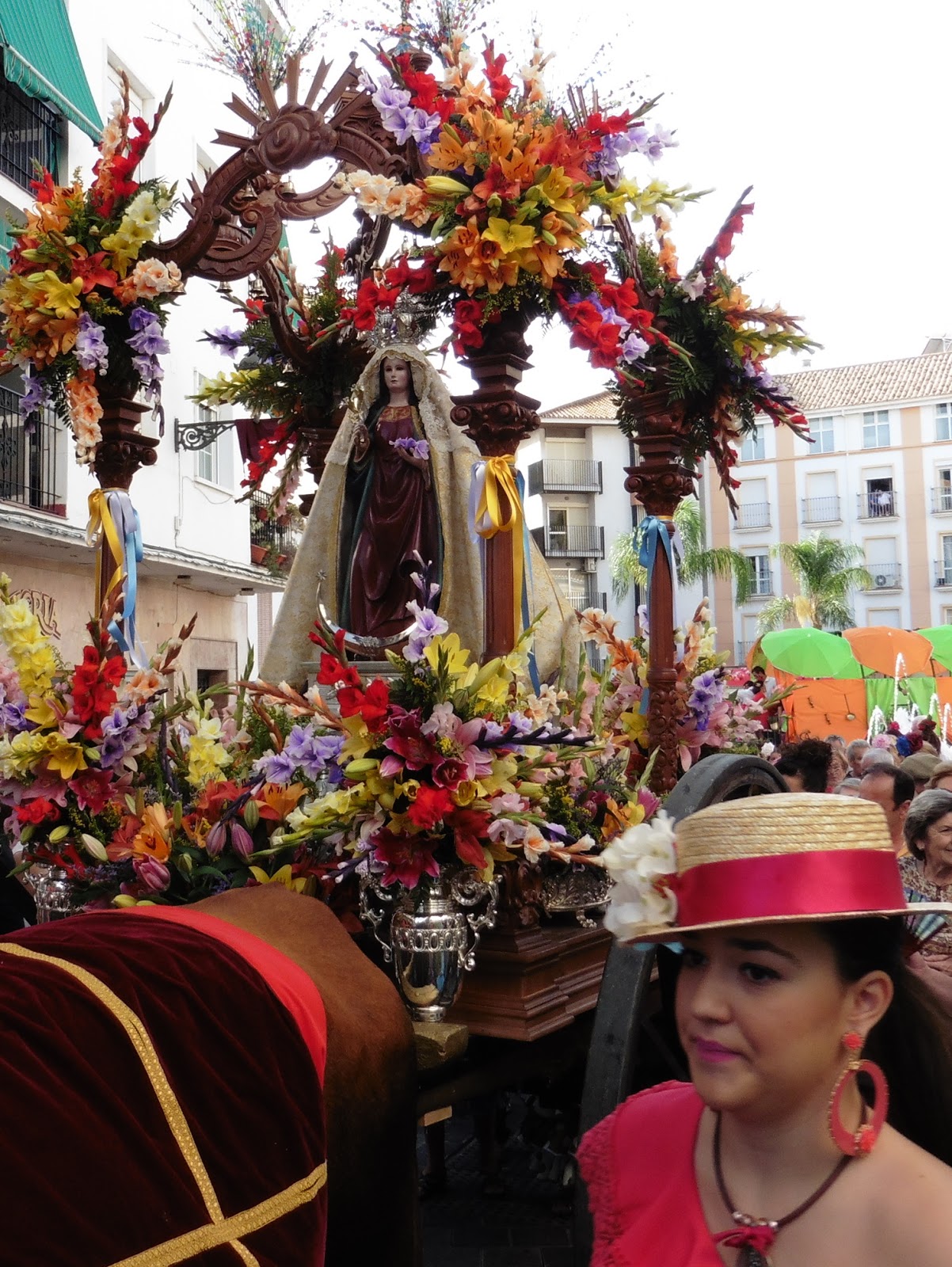
                           La Virgen de Flores passing a popular apartment block


             A mobile chiringuito (lots of pork products AND exercise).
 
                                   
                              The Jesús gang whooping it up at the El Señor chiringuito

                                        The IU paella (very nice too! and FREE)

Once The Virgin of the Flowers arrived at El Convento, almost everybody headed for one of the chiringuitos that had been set up. These are bars run by the hermandades and  cofradias, political parties and other groups trying to raise money.  They sell beer, refrescos (soft drinks), tinto de verano (red wine with fizzy lemonade),fino (a dry sherry drunk by real men) and water. Food is available too -  tortilla, paella, pinchos de gambas (prawns on a stick) etc. The routine is that you buy tickets to the value of what you want and then push your way through to the front (no queue) to trade in your tickets for food and drink. As the tickets are only valid at the chiringuito where you bought them you usually find a few unused tickets in your pocket the day after. It's all in a good cause, if you're fond of politics or religious processions. 
The best chiringuitos do a big paella which is very popular. We started off at 'El Capirote' which is run by the hermandad of Dolores Coronada, then we had a drink  at the Partido Popular bar (The Spanish Conservatives) and then another at the Izquierda Unida (United Left) to balance things up. The IU one was giving out free beer (and not just for the workers), olives and free paella. (We'll be voting for them at the next election). 

To round off the afternoon we went up to join the fun loving gang at the  El Señor de las Torres chiringuito which was heaving. Lots of flamenco, singing, dancing, eating and more drinking. 


This happens every year and I've never known it to rain. I don't know why they don't do it twice or three times a year. It always happens on the first Sunday after September 8th. if you want to book your flight early for next year.

Hundreds of happy pilgrims followed the vigin through town, turned left at the roundabout with the big arch, and surged up past Mercadona on route for El Convento which La Virgen de Flores calls home.


Just before they reached El Convento they passed La Venta de La Higuera. Ventas are restaurants which are usually found on  the roads between towns and villages. Most of them serve comidas caseras (home made traditional dishes) and are very popular at weekends. 
Next to the Venta La Higuera is La Fuente de La Higuera, a free flowing fountain where people used to queue up to fill containers with the spring water which flows from two pipes all day and night. I used to go up there with my plastic containers before dawn to avoid the crowds and still found a queue there . The water comes from deep inside the mountains and is regarded as the best in Álora. The tap water here is drinkable but it used to taste a bit like formaldehyde which gives a gin and tonic a bit of an 'off flavour ' and carries a whiff of the mortuary about it. It tastes all right these days but old habits die hard and people can still be seen filling up their bottles, containers and car boots with the stuff.

                                                  La Fuente de la Higuera

Last year someone noticed that the pipe that supplies the fountain is uncovered for some distance and is being polluted by a variety of unpleasant organic substances of animal origin. The ayuntamiento (town hall) decided that the water was a threat to public health and declared it 'no potable', which every Spanish person and millions of non Spaniards know to mean 'undrinkable' and they put up a sign to that affect. But you can't kid the Perotes. Many local people thought it was either a mistake or a hoax and continued to use the water for drinking. You can see a couple of people doing just that in the  photo. At considerable expense a much bigger sign was put up.


You can't get more explicit than this, in my opinion. It says,' Water not drinkable. Not suitable for human consumption.' It even has the official crest of Álora in the bottom left hand corner. Nah! must be a mistake.


That reminds me. Did I mention that we got our drains fixed? Turns out there was a 3 metre stretch with no pipe so it had all caved in. What a relief !

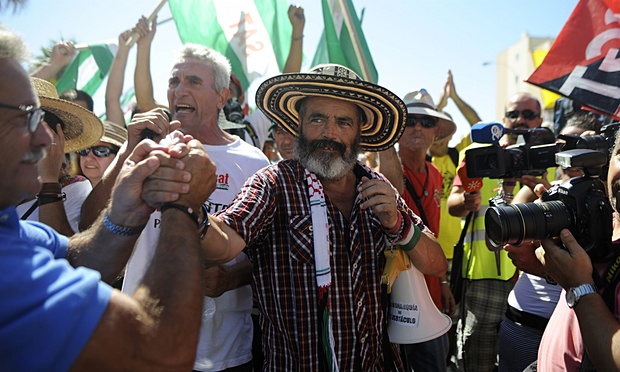
Yesterday Mrs Sánchez and I went to meet 'The Spanish Robin Hood'. He is Juan Miguel Sánchez Gordillo and he lives in Marinaleda a small rural  town 95km. (59 miles) from Álora where he has been the elected alcalde (mayor) since 1979 when the first local elections were held after the death of the Spain's best known dictator Generalisimo Francisco Franco. He is also a History teacher and leader of the political party Candidatura Unitaria de Trabajadores (Unitarian Candidacy of Workers)(CUT). Despite the similarity in name, looks and professional background Juan Sánchez has no familly connection with me nor with Mrs. Sánchez.


                                    Juan Miguel Sánchez Gordillo, Mayor of Marinaleda.

Since becoming alcalde of Marinaleda Sr. Sanchez has reduced unemployment to 5% (Spain's average is 25% and 34% in Andalucía). Everyone is paid the same wage, property is owned communally with no need for mortgages and there is no local police force. No wonder the Guardian newspaper described Marinaleda as a a 'communist utopia'.

In 2012 he led an attack on Carrefour and  Mercadona supermarkets in nearby Éjica and Aguilar de la Frontera where  supporters carried out a 'Supermarket Sweep' and 'confiscated' trolleyloads of basic foodstuffs which were then  redistributed among food banks. No wonder he gained the moniker 'The Spanish Robin Hood'. In 2013 he was sentenced to 7 months in prison for breaking into some unused land owned by the military, with the intention of using it for food production.

                                                              San- Che and his crew

Mrs. Sánchez and I were really looking forward to meeting 'San-Che' (geddit?) as we drove through Sevilla province in the baking heat of a September afternoon. Unfortunately we had left it a bit late (1.25pm.) and all the streets of Marinaleda were deserted. A very friendly lady interrupted her mopping to tell us where we could find the ayuntamiento (town hall). This was shut too. We should have made an appointment.


                                                 The town hall was closed

We looked around for a bar in case he was having his lunch break. The only one open was Bar Texas.. He wasn't there so we ordered drinks and had some fried calamares and asked the owner if Juan Sánchez was around.
'He doesn't come down here much', she told me, 'Try further up the road.' This wasn't specific enough for further serious investigation so we got back in the car and went home.


At the risk of over egging the pudding, dear reader, you might be interested in this little performance that Mrs. S and I witnessed in Casarabonela (once you learn how to say it you can't stop) last Sunday. Followng the great success of their village production of 'Scenes from the Spanish Inquisition' two years ago (see 'Nobody Expects the Spanish Inquisition'. 23rd. Sept 2013). Casarabonela (try saying it. It really does roll off the tongue once you've got it) has  cranked up its act, renamed the weekend 'Visperas', hired a van load of costumes and roped in nearly all the village for a massive 3 day event. (I was told the costume in the photo wasn't among those in the van).


 Last time we were there I was locked up and bought some cheese that I can still taste. This year every ounce of energy was put into staged episodes depicting  a visit by the Spanish Inqisition in 1569. Some people like dressing up a bit too much, I feel. Next year's performance is going to be called 'Heretic Pride'.

Mrs. Sánchez and I arrived a bit early so off  we went  to Cafe Nuevo and had some delicious Conejo con Ajo  (Rabbit and chips) (sorry Clive). By the time we emerged it was nearly all over so we just watched the 'curtain calls' (which lasted half and hour) and went home. No sign of a cheese stall this year. 


                                          Everyone  gave a bow - all 321 of them


                                                Lots of chairs but no cheese!

An English neighbour of ours turned up at his holiday home  last week without telling the chap who was looking after his house for him. It was being used as a marijuana farm.


He wasn't sure how to proceed so he went to the Manhatten Bar down by the station where he was advised, so I'm told, to call in the Guardia Civil in a few days. The caretaker has not been seen recently.  

Juanito Sanchez. September 26th. 2015


Wednesday, 16 September 2015

Now you see him. Now you don't. The Case of the Disappearing Baby Jesus.

Now you see him. Now You Don't. The Case of the Disappearing Baby Jesus.


Last Sunday was the day of the Romería de la Virgen de Flores (The Pilgrimage of the Virgin of the Flowers). The annual celebrations for Álora's Patron Virgin ended, as it does every year,  with a great procession from La Parroquia (Parish Church) in La Plaza Baja to El Convento out on the Ardales road where she spends the rest of the year. Nine days of misas (masses)and exploding rockets (remember those, Tommy?)  form the build up to the second biggest local event of the year. (Semana Santa) (holy week) will always take the number one slot.)

                                         La Virgen de Flores entering La Fuentarriba


Mrs. Sánchez and I live next door to Lina who is in charge of the whole show, so we feel almost involved. The Virgin of the Flowers, as you would expect, is yet another version of Mary, the mother of Jesus. 

There are hundreds, possibly thousands of these virgins scattered around Spain and South America, all with special names like 'The Virgin of the Miraculous Medal', 'The Lady of Carmen', 'The Black Madonna of Montserrat' and 'The Virgin of the Macarena'. Most of them are used in the Semana Santa processions but all towns and villages in Spain have a special one to protect them.

Alora's patron virgin, La Virgen de Flores' ,is adored by everyone and the celebrations have none of the solemnity, pain, suffering and death that comes with Holy Week. It's all about flowers, dressing up, music, happiness and, of course, eating and drinking. Despite the obvious connections between Mary, Jesus and Christianity you don't see much overt religious fervour on the day of the Romeria. The village priest walked past while we were watching the procession this year . He was wearing a  t shirt and chinos and had a cigarette on the go. The Church knows when to keep a low profile.

The bars in the Fuentarriba (Top square) shut down on the day of the Romería; partly out of respect and partly for safety as later in the day there are a lot of fino-fuelled horsemen wandering around. Paco, the boss of Bar Alegría, once had some of them ride into his bar on big horses demanding drink. It's all good fun.

As usual on the Sunday of the Romería our street gets busy, noisy and smelly before dawn as smart mounted señoritos, la carreta (the cart) and two massive vacas (cows) pass our door, all heading for the end of the street where the horses and cows crap all over the place and the cart and the virgin are dressed up. I usually go down there with a bucket and shovel to see if they want any help and to check how things are getting on.


 La carreta (cart) and decoration team


Las vacas (cows)

 By the time everybody in Casa Sánchez was up and about La Virgen was already decked out in flowers and ready to ride up Calle Atrás pulled by the two beefy vacas. These sturdy and often reluctant beasts  are encouraged to progress up the steep hill by men wielding long poles with nails in the end. By the time I'd got everybody out of the house we'd missed the start. Cows, cart, virgin and followers on foot and on horseback were already up Atrás and entering  Fuentarriba (the top square). I legged it up Calle Zapata and Calle Parra just in time to take some pictures of the rapturous welcome.


     La Virgen de Flores enters Fuentarriba (showing happy man with a pointed stick)


No self-respecting Virgin Mary would be seen in public without her  little baby Jesus, unless it's Easter and she's holding the body of Christ or weeping. 
I've no idea why, but all the baby Jesuses I've seen, and I've seen more than a few, I can tell you, tend to look a bit on the mature side.

Anyway, when I found Mrs. Sánchez and the family she immediately pointed towards the virgin and, in a fair imitation of Miss Marple, exclaimed,

'Something's up!' 
'Up? What's up?'
'Where's the baby?'
'What baby?'
'The baby Jesus. He's not there.'

'Some mishtake shurely', thought I but she was right! The baby Jesus had disappeared and nobody else appeared to have noticed. All Mary had in her arms was a bit of cloth. Everything was going on 'como si nada' (as if nothing had happened.)
'We'd better tell someone', says Mrs. S.

.

                                              La Virgen de Flores (sin El Niño)

'No. Wait!' says I. 'Perhaps this has happened every year but we've never noticed.'
 I checked my camera for the earlier pictures and there he was, safe and sound in his mother's arms. 'The incident must have happened on Calle Atrás'. declared Miss Marple.


                                            La virgen de Flores earlier (con El Niño).

 We watched the lone virgin pass through the square followed by a parade of Carrozas (decorated floats packed with beer, fino, ice and nibbles), mounted caballeros (horsemen), señoras and señoritas dressed in beautiful figure-hugging flamenco dresses and a long line of peregrinos (pilgrims).

                                               Some señoras and señoritas.

Then we went home for a proper breakfast.

The next day our drains backed up and sewage started seeping out through the patio tiles. I called a couple of reliable builders and one arrived within the hour to sort out the problem. We'd planned to take the family to the beach en route to the airport but instead we took a leisurely al fresco breakfast entertained by the builder drilling into the patio and the sight of previous meals.He's coming tomorrow to finish the job. Hey ho.

Yesterday I bumped into our next door neighbour, Lina and asked her what had happened to baby Jesus. Apparently the baby is fixed to his mother's lap by an espiga (spike) (ouch!). As the cart wobbled through the cobbled Plaza Baja and up the cobbled Calle Atrás, the espiga came loose and El Niño almost crashed to an early demise under the wheels of the carreta. Quick thinking and a spectacular dive and catch  by one of the young lads there saved the day. He'd make a good slip fielder.

Juanito Sánchez 16th. September 2015