Saturday, 15 August 2020

Heroes of Álora. Paco Mañoño.

Paco Mañoño


The first thing to say about Paco Mañoño (Man-yon-yo) is that 'Paco Mañoño' was not his name. He was known by everyone as just 'Mañoño', but so were his brothers, his uncles and grandfather too. It's a family 'apodo' (nickname) and lots of families in Álora have them. Nobody can remember why Paco's family were given this one, it's not offensive at all and most people are proud of their family apodo. I had to make up the spelling because I've never seen it written until I just wrote it. I doubt if anyone has seen it written.. Paco Mañoño had more than his fair share of apodos because 'Paco' is an apodo too!

Paco showed me his DNI (ID) card once during a heated, if perplexing, discussion about his age. The picture was him all right, same very serious face, but his nombre de pila (Christian name) was given as  'Francisco' and neither of his two apellidos (surnames) was Mañoño. I didn't believe his date of birth either - Paco had lived a hard life, though. I lost the bet about his age.

'Paco' and 'Curro' are short for Francisco (nobody knows why), in the same way that Pepe is short for José,  Lalo is short for Eduardo and Maripepa is short for Maria José. It must have been great fun making all these apodos up.

Some Franciscos don't like being called Paco at all, and prefer Franci (Fransie) which sounds a bit posher, and a bit gay, in my opinion.

Generalisimo Francisco Franco Bahamonde, Dictator of Spain from 1939 to 1975 was sometimes  referred to as Paco or even Paquiito (little Paco), but not to his face and only by people who were tired of living.


                      'Don't call me Paco, please,sir. My name's really Francisco'.

Paco Mañoño was one of 5 Mañoño brothers. I only ever met three of them ; Paco, Juan and Rafael. They lived in a house in  Alora's most picturesque street, Calle Negrillos, just off  La Plaza de la Fuente Arriba (the Top Square), with their mother until she died about ten years ago. 

                                                             Calle Negrillos

Although  Paco, Rafael and Juan shared a common interest, alcohol, you never saw them together. Raphael didn't go out much anyway, but the other two could be seen most days around the Top Square having risen early that morning to grab all the smartest clothes.

Paco would usually stride through the town from end to end and back again, bent forward, with his hands clasped behind his back, looking serious. Juan busied himself arranging chairs outside the bars and collecting a few empty glasses.  I don't know if anyone ever paid him. Paco had a proper job in Marbella until the 'crisis' of 2008 and so had enough money to drink in the bars around the Square that still allowed him in. It's hard to imagine it now, but none of the bars in La Plaza de la Fuente Arriba had tables outside until quite recently. Smokers and non-smokers mingled happily together inside the bars in all weathers or spilled out onto the square. Spitting out sunflower husks was compulsory, ashtrays were rare and all litter was dropped on the floor to be swept up by the camarero (waiter/barman) later on. Ah! The good old days.

The recession and the death of their mother set the Mañoños further down the downward slope. At about this time Paco and Juan could often be spotted passing through the square sporting a variety of injuries - black eyes, broken bones, bandaged heads etc. We suspected domestic violence, but it turned out these were self-inflicted wounds.


                                       Juan Mañoño (with wounds


One of the natural enemies of the dedicated drinker in all cultures is gravity, and falling over is an occupational hazard, particularly at night. In Álora it usually involves landing on a hard surface.There's no shortage of those in Álora, indoors or out, and there are few, if any, stair carpets. The Mañoños had an abono de temporada (season ticket) for 112  (the emergency ambulance service). The paramedics had their address in 'my destinations' on their TomTom and allowed the brothers a small discount if they injured themselves away from home. Calle Negrillos is a steep, stepped street. (another potential death trap for the careless inebriate and someone with a lisp), so recovering an unconscious injured person from down there can be tricky.

Mrs. Sánchez and I first met Paco Mañoño in La Taberna de Antonio on Calle  La Rampa back in 2001. In those days 'Antonio's was popular with members of the Real, Sacramental y Ilustre Hermandad y Cofradía de Nazarenos de María Santísima de los Dolores Coronada y Soledad, better known to us as 'The Dolores Crowd', a local religious club dedicated to the most important statue of the Virgin Mary in the town. Paco loved The Virgin of Dolores more than anything in the world, even Cruzcampo.

                        Dolores Coronada coming down our street.

We used to spend a lot of time in Antonio's in those days - well, almost every night to be honest.  Ana Molina (Mrs. Antonio), who did all the cooking for the restaurant, befriended us on the first day we showed up in Álora. and from then on she was reponsible for our social lives for the next ten years.

 La Taberna de Antonio (Ana on the left, Antonio on the right)  
 
Ana kicked off by re-christening us 'Juan' y 'Mowri', got us to write something in her visitors' book and cooked us a few platos tipicos del pueblo which were delicious.She spoke no English, insisting that we were going learn Spanish 'rapido'. Her method was to refuse to listen unless we tried to speak Spanish, and then criticise our efforts.
 
It was some time before we realised that, although everyone in Álora can understand Castellano, which is the official Spanish language that we were trying to learn, none of them speaks it. And nobody didn't speak it as convincingly as Paco Mañoño.
 
Antonio's bar/restaurant was open during the day but didn't start to get busy at night until just before midnight.
Ana introduced us to everyone that came through the door and they immediately became our best mates, all speaking 'Perote' which is a form of Castellano which you have to speak very quickly, taking care not to pronounce the consonants 's' 'd' 'r' 't' and others, probably.
Once we realised what the score was, we learnt it in no time and tried it out with Ana and Antonio's late night clientele, who consisted mainly of The Dolores Crowd.  It helps if you can speak in a growly voice, too. The best thing about trying to speak 'Spanish' in Álora is that all the Perotes (locals) love you for it, even if you're talking complete gibberish. It's the thought that counts.
 
After a couple of years we'd made quite good progress so much so that, with a lot of guesswork, gestures and 'Mas despacio por favor' s ( 'A little slower, please'.) we could make out what a few  people were trying to tell us.
Paco Mañoño took a liking to us from the start, especially to Mrs. Sánchez. He was a very friendly chap and never noticed that we weren't understanding a single word, even when he was sober. He was always pleased to see us. Almost everything he said was spoken with passion, (a very 'flamenco' way of talking very popular in Álora) and he must have been smoking 50 Ducados a day to maintain that growly voice.
Finally, one night, after yet  another embarrassingly futile session of smiling and head nodding with Paco's arm round my shoulder, I collared Antonio at the end of the bar, which is where he sat most of the night.

'¿Qué me dice Paco? No entiendo ni una palabra.?
 
 ('What's Paco saying ? I can't undersand a word?').

'No te precupes, Juan, ni yo tampoco.'

('Don't worry, Juan, I can't either')  

We became so pally with the Dolores Crowd that we half expected to be invited to join the club. We were invited to many of their 'do's', which always involved food and drink. I was once asked to photograph the investiture of their  new Hermana Mayor, Ana Molina's cousin, also called Ana Molina.  It was a long time before we realised that all these do's were  ´fund-raisers' for the big event of the year, Semana Santa, when Dolores, the star of the Easter processions, has to look in tip-tippety-top condition, out-flowering and out-candle-ing all the other virgins and most importantly, Jesus de las Torres, her main rival and partner in La Despedía show on Viernes Santo (Good Friday).


 El Señor Jesús de las Torres and his mum, La Virgen de Dolores Coronada, say their goodbyes (despedía) in La Plaza de la Despedía (the Bottom Square) before he is whisked away up the very steep Calle Ancha by some strapping young soldiers  to the castillo (castle) where he will meet his fate.


Paco Mañoño was always ready to help out with any work that the Dolores Crowd needed doing. Despite his  wayward ways he was liked and respected within the Hermandad and took part in the processions. In the picture at the top he is wearing the black cassock and badge  of the Dolores Hermadad. Even though Cruzcampo cerveza (or San Miguel or Alhambra) was his second passion he would not normally be seen drinking on parade. On this rainy Viernes Santo the procession had halted in the top square for a decision to be made about whether to call it a day or carry on and risk getting Dolores wet. As luck would have it they put The Virgin down on her special stand right outside Café/Bar Madrugón. Miraculously a large glass of Cruzcampo appeared in Paco's hand. Eventually the hermanos and hermanas decided to carry on with the procession, amid loud cheering from the well-oiled devotees and spectators.

Every year, but not this year, after the Despedía performance has finished, the entire Dolores Crowd, the forty or so soldiers plus other hangers-on head  up to Los Conejitos restaurant for a slap-up lunch. The still hungry and thirsty crowds head up Calle Atras for the busy bars in the Top Square to  make way for a gang of council workers to begin the work of clearing  the bottom square, which is usually knee-deep in empty beer cans, paper plates, plastic tumblers and sunflower seed husks.

I strolled down there one year to take some artistic shots of the rubbish and came across  Paco Mañoño sitting on the  steps of the Parroquía, still in his cassock, smoking a cigarette. He looked only a little worse for wear, but I'd presumed he would be up at Los Conejitos with rest of the Dolores Crowd. Apparently you have to pay for the meal. It was always hard to judge Paco's mood -  he always looked a bit melancholy. Perhaps it didn't bother him, but he deserved better than that.

                                                       La Virgen de las Flores.

 Every hot September, but not this year Álora celebrates another important virgin, La Virgen de las Flores (The Virgin of the Flowers). After nine days of misas (masses) leading up to The Day of the Virgin (September 9th.) Alora's  'romería' takes place. 

On the first Sunday following September 9th. La Virgen de las Flores sets off, on her throne, from La Plaza Baja de la Despedía (AKA. The bottom Square) and up the steep Calle Atrás, pulled by two prodded  cows . In the Top Square she meets a  procession of decorated carts, tractors, lorries and horsesmen,with their riders and señoritas in traditional costumes, all well provisioned with food and drink (ice-cold beer or ice-cold dry Manzanilla 'sherry').They all follow her up the old Ardales road to El Convento Las Flores where a few thousand revellers have already started a big party in her honour.


It's a big day and lots of fun. It's also a big day for the Dolores Hermandad (Brotherhood) which sets up a long bar and a massive toldo (a canopy for shade- it's usually baking hot) called El Capirote which supplies food and drink, at a price. It's their biggest fund-raising event of the year.

                                             El Capirote (view from the bar)

The 'toldo' is erected the day before (Saturday). Early on one of these Saturday's I got a phone call from Ana Molina.

'Juan?  ¿Qué haces hoy?  hace falta gente para montar el toldo.'

They were asking me to help to put up the toldo. The temperature outside was already well into the 30s. Ana did not, and still does not, take 'No' for an answer. I didn't even try.

Mrs. Sánchez drove me up to the Convento where ten or so men from the Dolores Crowd were already assembling the big steel frame for the toldo. Paco Mañoño was there, of course.

'Pick me up at about one o´clock. ' This looked like hot work, and it was.

Paco was surprisingly strong for his slight build and he worked like a Trojan, shouting orders to the young hermanos (brothers - not Paco's, of course)  Everyone was sweating cobs (as we say) as a  few of the old hands climbed up big ladders to pull the toldo across the frame. It was past midday and I kept checking the gate to see if my rescue party had arrived..

Instead of Mrs Sanchez, a van pulled up and more hermanos started to set up the bar. Within minutes they were testing the beer.  It was already cool enough to drink! 

¡Qué sorpresa tan agradable! (What a pleasant surprise!.) It was no surprise to Paco. He was very thirsty and ready to go.The toldo was fixed firmly to the frame - it gets windy up at the convent - and we all headed for the beer.

That's when Mrs. Sánchez appeared. Much amusement all round as we drove away.

¡Hasta mañaña!  (See you tomorrow!).

The next day was el septimo cielo (seventh heaven) for Paco. As a reward for working on the toldo, I imagine, he was allowed to work behind the bar serving food and drink. It combined both his aficiones (loves) - working for La Virgen.... and beer!

We arrived at el Convento the next day at about 2 o´clock. The party was in full swing and the sun was very hot. El Capirote was heaving. You have to buy tickets and then pay for your drinks and food with the tickets, just like we used to do at school bazaars. It's a bit of a fag and eventually tends to lapse into a mixture of cash, tickets, who you know, and lots of pushing.

Paco was very busy, didn't recognise us, and was no help at all in getting my order (cuatro cervezas). I suspected that he'd been sampling the goods a fair bit as well. It's hot work, after all.  We were told later in the week that he'd collapsed from the heat, etc. and was carted off in an ambulance, with a contented smile on his face, by his old pals the paramedics. That was the last time he was 'called to the bar' by the Hermandad.

Rafael was the first of the brothers to die. Mrs. Sánchez and I usually go back to our summer residence in England for three months in June, and when we return it can be some days or weeks before we realise that someone isn't around any more. 

The other two carried on their lives in much the same way for a few years, but Paco seemed to spend most of the day standing by the traffic lights gazing down Calle Carmona as if he was waiting for someone.. He often showed no sign of recognising me and if he did talk to me, he'd lost his spark.

All three are gone now. So is La Taberna de Antonio and Antonio himself. 

Álora is changing all the time. Fortunately the pueblo hasn't suffered too badly from the Coronavirus pandemic - so far at least.  We haven't been back since February and don't expect to return until October. 

¡Hasta la próxima vez, Álora!

Juanito Sánchez August 15th 2020.


Tuesday, 28 July 2020

Man Not In Álora Escapes to Treasure Island. A Pasty a Day Keeps the Virus Away.


Man Not in Álora Escapes to Treasure Island. A Pasty a Day Keeps the Virus Away.

 
Imagine that you went to sleep and woke up in a Coronavirus-free world. Imagine that you have been transported to a remote island where there is no Covid-19 and never has been.
Well, that's what happened to Mrs. Sánchez, Monty and me two weeks ago - and it wasn't a dream! 


We were on the Island of St. Agnes, one of The Isles of Scilly.


It´s 28 miles south-west of Land's End and is the most southwesterly southwest place in the British Isles - or the  UK, whichever you prefer. The population of the five inhabited islands is about 2203 and so far not one of them has been affected by  Coronavirus!

The most southwesterly southwest place in the British Isles...down there on the left.

We'd booked a holiday in this sub-tropical island paradise in January, paid a deposit for a week in a self-catering 'cottage' and invited our daughter and grandaughter to join us.
You know what happened next.

As part of the `lockdown' measures almost all transport to the islands by sea and air was stopped. Only essential supplies and ´key workers´ were allowed in or out and even transport between the islands was banned. Fishermen were locked down like everybody else in the UK (with one or two noteworthy exceptions!).
All in the same boat? What boat?


'Sorry chaps, can't stop. Got a boat to catch to get my eyes tested.'


Since the Lockdown on March 23rd., Mrs. Sánchez and I have not been out much, which is why avid readers of this previously popular publication may have been disappointed by a break in service. Let's face it, there's not much to write about when all you're doing is gardening, going out to the shop once a week, buying stuff on line, and looking out of the window, which is pretty much what we've always done. We bought a shiny new car in December which has looked nice, parked in front of the house gathering dust.
Can't complain!


Almost every day's been like Christmas day at our house, and sometimes more frequently than that, as yet another delivery arrived of something that one of us took a fancy to and  that looked like a bargain the other night after a couple of drinks.

              Our Amazon delivery man.

It looked as though the holiday we booked in January for July was not going to happen, even if we survived until July, anyway, as the number of new cases kept increasing and people were dying in the UK at the rate of over 1000 a  week.
Birmingham was top of the list at one point.


There seemed to be no light at the end of the tunnel until everybody's favourite uncle, Boris Johnson, decided that we could all go out again to spend all that money we'd been saving up by not going to restaurants, beach cafes and garden centres.
I wish!

The holiday was back on, if we could find someone to transport us across the sea to Scilly.
 
The campsite pictured in this Guardian story is on St. Agnes.

Looking back, we didn't give much thought to what the Scillonian residents thought about it at all. We were experiencing a bit of a 'frenzy' and I suppose we thought that an influx of free-spending stir-crazy 'mainlanders' would be a welcome and much needed boost to the Islands' economy.


.......until some of the people on the island of St. Martins made things clear in an open letter that made the national press.
In short, they weren't happy at all. Most of their businesses had shut down and any visitors desperate enough to come ashore on their island had better watch their steps or else. Indeed, if you were to have the misfortune to be staying on the island and showed symptoms of the lurgy, you would end up having to pay for at least another two weeks accommodation in lockdown and pay compensation to the people who had booked those two weeks, to boot!


                   St. Martin's....keep out!

Many Islanders are, indeed, not happy about letting infected mainlanders on to their pristine paradise....and who can blame them? Not me.


Cornwall has seen very few cases of The Virus, and Scilly has had exactly none, so you can imagine how many people in this faraway so-far-safe sanctuary feel about a sudden influx of possibly disease-carrying holidaymakers.


Seven days into the relaxation of distancing rules and the re-opening of many campsites and self-catering places, we left our lockdown lodgings for the drive down to Penzance.

Our forwarded bag of essential items (dog food, wine, herbal teas, gin and Black Country pork scratchings etc). had been last seen leaving Parcelforce's Bodmin depot a week ago.
 

The escape route from Brum took us down the M5 motorway, heading for Penzance, which is in Cornwall.


The sense of freedom was a bit unnerving - as soon as we set off in the car, everything seemed back to normal again in our own space - until we stopped at Oakhampton for a coffee.  -  masks, spacing-out in the queue, nervous people, nervous staff.
Back to reality. We continued in a sober mood until we met our daughter and grandaughter opposite St. Michael's Mount which was copied by the French and named Mont St. Michel (blinking cheek!)


Spot the the difference.


Mrs. Sánchez and Monty were unimpressed by Cornwall's iconic island.

A twin-propellered 'Otter' flew us from St.Just-in-Penwith International Airport  to St. Mary's International Airport on the Isles of Scilly. The car journey took 5 hours. The flight took 15 minutes with a following wind.

                           An Otter

I spent the whole of that time with mild concussion after bashing my head on the very solid aeroplane doorway after being warned to 'Watch your head!'.

A masked boatman then whisked us across the sea to the 'off island' of St. Agnes and there we were,  on Treasure Island.


St. Agnes, Isles of Scilly ( an 'off-island')

A 'cordon sanitaire' had been thrown round Scilly during the dark days of lockdown. The passenger ship Scillonian 111 stopped sailing. Only 'key workers' were allowed on the reduced flights. Scilly's entire police force were deployed to repel unwanted immigrants. - Rob at the airport and Shirley on the quay. You had to have a very good reason to be allowed ashore, I can tell you!
Even pasty imports were suspended, lobster and crab fishermen were 'grounded' and 'off- islanders' couldn't even go over to the Co-op on St. Mary's island to do a bit of shopping´.

                      Obadiah Trenwith

Obadiah Trenwith, a 105 year old World War 2 veteran had his entire collection of WW2 floating mines commandeered by the Scilly Defence Militia to be deployed as 'deterrent obstacles' at strategic points round the islands, and nets were lowered into the sea to intercept frogmen, frogwomen, a few pollock and mackerel.
Nobody was allowed to pass - not even Dominic Cummings or Boris Johnson´s dad.

                    
An 'Obadiah Obstacle' on the beach at Porthcressa....Hmmm. Looks familiar

Most (85%) of the people living on Scilly  depend directly or indirectly on 'visitors' and 'trippers' (there IS a difference...see Man in Alora July 2014) for their livelihood now that the daffodil industry  has almost disappeared and piracy and 'wrecking' are illegal and smuggling is considered vulgar because of its associations with drugs and people trafficking.


The islanders are split down the middle about the easing of lockdown and distancing rules. On St. Agnes all but two of the places to stay have closed their doors for the whole season and may face bankruptcy.

Hugh Town, on St. Mary's, the largest of the islands, has most of the shops, pubs and hotels. Much of the work is seasonal and nearly everybody in work is on the minimum wage (£6.45 an hour), mostly in shops, hotels and as cleaners.
Here's some shops you won't find there:
Shoe shops, pharmacy, charity shops, bookies, phone shops, electrical goods shops, pound shops, pawn shops, jewellery shops, Halford's, W.H.Smith, antiques shops, KFC, McDonalds, Burger King...I could go on.

The Co-op is the most important venue in Hugh Town and always has a queue outside, owing to strict distancing rules, which blocks the pavement forcing pedestrians to step into the street to avoid a virus infection and risk being run over by one of the 700 motor vehicles which speed up and down the island's 9 miles of road. (all vehicles are MOT exempt).

                                              The queue outside the Co-op

.
St Agnes is one of the five inhabited islands and has a resident population of about 85 people. There's a campsite, a pub, some holiday cottages and a couple of B&Bs on the island which all depend on the holiday trade.  At Troytown, the campsite has re-opened, along with its 3 holiday lets. 


 St Agnes Post Office and Store. Click and collect and telephone orders only

The shop is only taking internet or phoned orders and the only cafe, Coastguards, is just serving people at outside tables, which is OK when it's not raining or blowing a gale. The pub has a very strict queuing system but is serving some meals inside to widely-spaced tables. It's the 'new normal'.  


As we landed at St. Agnes quay on July 11th. we were wondering what sort of a welcome we would receive. Usually people are very friendly and over the years we know a few of the locals. 


The Turks Head Pub was our first stop and the difference was stark. It was the first pub we'd been to since January. There was a line drawn a metre from the bar, hand sanitiser at the doorway, masks, and lots of notices. Someone on St. Agnes must have bought a laminater (on line, presumably) and been let loose on the island. It felt a bit unwelcoming and I was on pins in case the owner remembered me from three years ago when we had a bit of a tiff. He didn't recognise me. Naturally everyone was very nervous. Visitors only began arriving a week before. 


As the week progressed we had all got used to the 'new normal' at the pub. Food was being served outside ('preorder your pasties before 10.45am'.) and with possibly the best view, with a drink in your hand, from any pub in Britain and possibly the world.

There's no getting away from it, the majority of the St. Agnes people were still staying in. The farmers were working, the post office/store was still selling groceries by phone or online.  The only cafe, 'Coastguards' was serving take-away meals  in their garden and Troytown with its suddenly busy campsite, holiday lets and farm shop was doing very well, particularly with their wonderful ice cream.


It's a massive gamble. We were told that if as few as 2 cases of Coronavirus  were to be detected on any of the islands, everything and everyone could be forced into lockdown again.
That was when I realised the enormity of the problem we visitors were causing for the local people.


Troytown farmer Tim Hicks

!0,000 years ago The Isles of Scilly were probably one big island and even by 500 AD. all the Islands except St. Agnes were joined together. Today you can still walk across from island to island during a low Spring tide. But sea levels are rising all the time and Scilly's days may be numbered. The Scillonians have always struggled to survive. By the 16th. century nobody lived there at all. 'Lawlessness and disease' caused that, apparently (!!). 
Not one family living there at the moment can place their ancestors on Scilly before the 18th. century.

The Islands are picturesque , wild, unspoilt and peaceful. Life is governed by the weather and the tides. Not long ago daffodils were the basis of the economy there - they are in bloom in November. Now the islands depend on 'tourism' and tourists come in all shapes and sizes. 
We had a wonderful time there. I hope we left it as we found it....Coronavirus free.
We've already booked for next year.

Pasty News

There are good Cornish Pasties to be had at The Turks Head on St. Agnes.
The deli on St. Mary's , now called Hugh Street Café does some good pasties, with several vegetarian options ,as does Kavorna further down the street on the left. The ones at The Café on the Quay are all right, but the best one I had was at the Airport Café as we waited for our flight back to St. Just.  Good luck and 'Buen viaje' if you fancy trying one.

A pasty a day keeps the virus away...I hope.

Juanito Sánchez.  July28th. 2020


Thursday, 21 May 2020

There are worse things than not having a haircut for four months. The Wild Man of Borneo Not in Álora is staying alert.


There are worse things than not having a haircut for four months. The Wild Man of Borneo Not in Álora is staying alert.

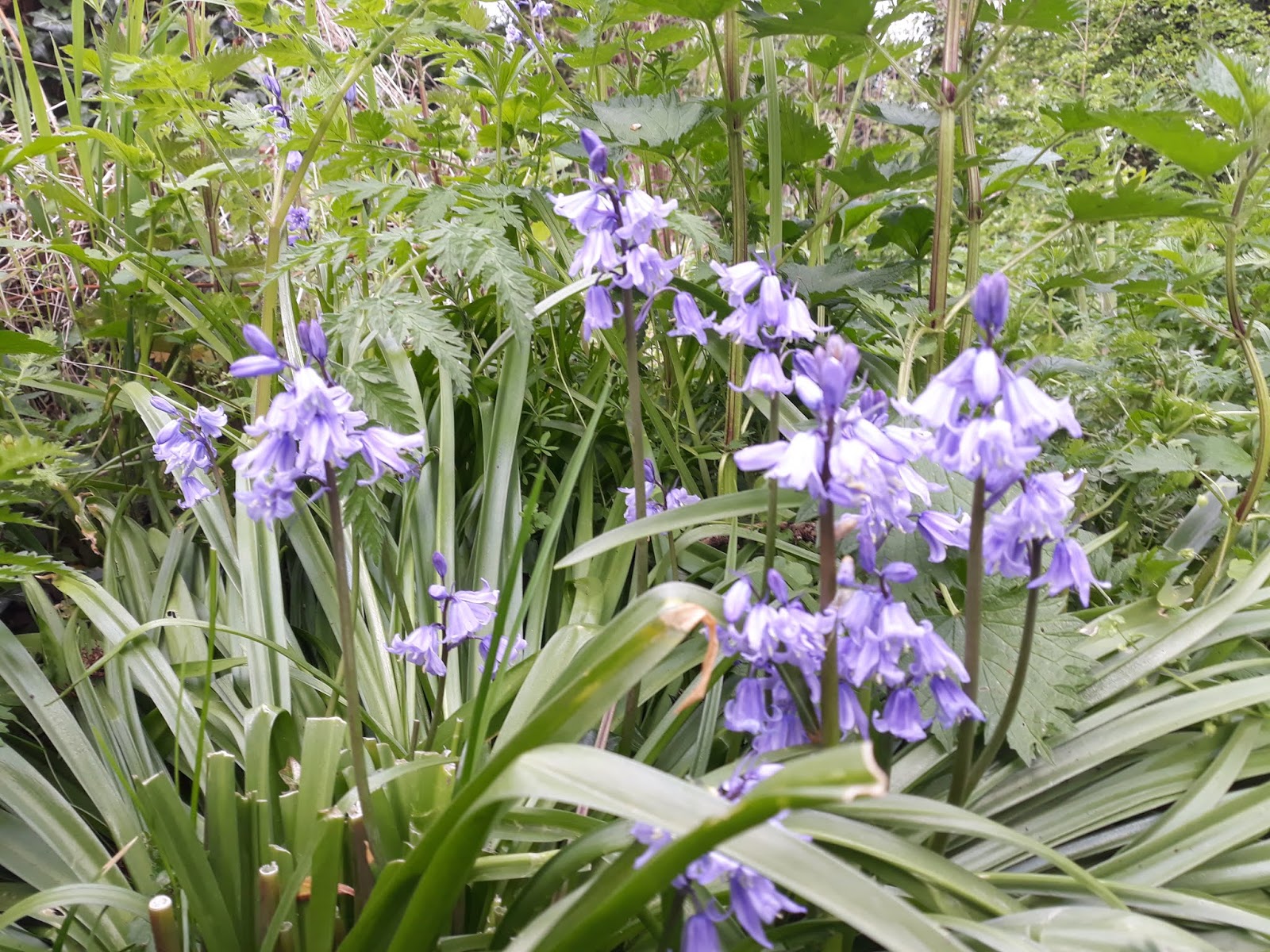
                         Hyacinthoides non-scripta

When a dramatic disaster happens to you, for example having all your documents and money stolen in North Korea or falling overboard from a cross-channel ferry or being captured by terrorists and held to ransom (it could happen), you can always take some comfort by imagining what a good story it will make to tell to your mates at work , your family and friends when, and if, you survive.

That's the trouble with this Coronavirus / Covid 19 pandemic - all the people you could tell about your experiences at the moment are having the same or similar ones; some more dramatic and disasterous than yours. Even if you have friends on the other side of the world or in Cornwall or even in the Turks and Caicos Islands (Hello loyal readers), you can bet your boots that they've got their own Corona story to tell.
You can't even say to yourself,  'Just wait till I tell my grandchildren about this.', because they're in it too, and you may never see them again anyway.

That's why so many people have started to write a diary - not just to try and get it published and make some money (you have to be a celebrity to try that one) but to be able, if you get through it all alive, to look back on these traumatic times and have a good old laugh. I know I'm looking forward to that.


Having said all that, Mrs. Sánchez and I have had a pretty easy time of it so far. As long as you don't want to go out and can limit your Coronavirus news consumption to only once a day, the minutes, hours, days and weeks just slide by.

We're on Day 59 of lockdown today in the UK, or at least in Scotland and Northern Ireland and possibly Wales, we are. Nobody's really sure what's allowed at the moment in England and by the look of things round here, they never did.
Birmingham, and the Midlands in general are getting a serious biffing from the virus, but sitting here in the expansive luxuriant garden of our winter (and summer) residence on a sunny day with a glass of wine or a cup of tea, it´s easy to forget that we are in the middle of the worst worldwide catastrophe since World War One - you just ask Sir Colonel Tom.


Mind you, some places haven't even got the virus - such as Turkmenistan, Tonga, the Isles of Scilly (in Cornwall) and Ambridge. Bully for them. We booked a holiday in the Isles of Scilly for July but the word is that most Scillonians don't want any visitors from mainland Britain, and who can blame them? not I! - as long as I get my deposit back.

Back in Álora, which we are not, things are starting to get back to ´normal'. Pedro Sánchez (no relation), the Prime Minister of Spain has extended the State of Emergency again but he's introduced 'un horario por etapas' (phased timetable), nothing to do with tapas, which are banned). Movement up through the phases may vary across the regions and within the regions depending on the number of new cases and deaths.

Fase 0, (Phase 1), which began for the whole of Spain on May 4th. was to last a week, during which some businesses could reopen, such as restaurants , but only for food deliveries to the home. You could go out for walks with people from the same household and play 'individual' sports.
 Almuñécar - La Herradura Coronavirus COVID-19, Announcements ...
After being banged up for months on end you can imagine how keen everybody is to get back to normal, especially, as in a few weeks, it's going to be so hot that no-one will want to go out anyway.


Everyone was supposed to move to Fase 1 on March 11th. but Málaga and Granada provinces in Andalucía have been told they have to wait another week. That includes Álora. where they have just moved into Fase 1 this Monday.

Fase 2 starts next Monday 25th.May, but not for Málaga and Álora unless the 'hostelería' sector ( bar, restaurant and hotel owners) can persuade the Junta de Andalucía to reduce their sentence for good behaviour.
A couple of usually unreliable scources have told me that despite the one week delay, some Perotes (Álora people) have given the Junta the 'corte de manga' and are carrying on como si nada. (as if they didn't care). Imagine that!


      Ex-Prime Minister Rajoy giving a corte de manga to the Fraud Squad

It doesn't look as though Mrs.S. and I will be able to get down to Álora before the end of August. Thank goodness we have very good neighbours who are keeping an eye on our garden there. Thanks, Julie and Alan!
Our garden here in Brum has never been better. We realised that we haven't seen it in Spring since 2002! There are plants out there we didn't know we had - bluebells, cornflowers, forget-me-nots, triffids, Jack-by-the hedge, Herb Robert and heartsease and lots of hierbajos pertinaces (stubborn weeds). 
Mrs S. insists that weeds are 'just flowers in the wrong place'.
It took me two weeks to find the right place for them all. They're in black bin bags now, waiting for the day when the queue of cars outside the Council Recycling Centre (tip) goes down a bit.
Our daily walk through Moseley Bog  (It's much better than it sounds) has kept us relatively sane, which is considerably saner than 'Barmy Sue' who lurks  there asking people to introduce their dogs to her hamster.

The bluebells in Moseley Bog have nearly finished now. They were spectacular.

                   A swathe of bluebells in Moseley Bog

The majority of them are 'Spanish Bluebells' which 'the Victorians' brought to Britain, as it was called in those days, as garden plants.

                                  English Bluebells

            Spanish Bluebells. Can you spot the difference?


They spread so quickly, along with grey squirrels and cholera, that many prominent people, such as Charles Darwin's cousin , Sir Francis Galton, F. W. Neitzsche, H.G. Wells, G.B. Shaw, W.C. Fields and W.G.Grace started a campaign to stamp them out (literally). 

                                   Types of Bluebell.

They were worried that the immigrant Spanish Bluebell would cross-breed with the native English Bluebell, dilute the race of Bluebells and leave us with a 'mongrel' Bluebell.

A lot of, mainly rich and clever, people in those days were very worried about 'regression to the mean' ( everybody ending up not very clever and not very poor) and the only way to stop this was to stop rich and clever people mating with poor and stupid people - a bit like Spanish (inferior) Bluebells mating with (superior) English Bluebells).

                                       Eugenics

Sir Francis Galton misinterpreted his cousin Charles Darwin's theories about 'natural selection' and invented 'Eugenics', which proposed selective breeding of humans and led to the idea of a master race.

'You must have a Eugenic Certificate'


Eugenics became very popular in the USA and resulted many years later in Donald Trump.

Galton's ideas were set to music by W.R. Wagner and used by A. Hitler to  justify the mass murder of millions of people.

Anyway, the future looked bleak for the poor old Spanish Bluebell until Percy Pickles, a young Australian backpacker, earning a few pounds as a research assistent at Cambridge University stumbled on the discovery that the genetic makeup of the Spanish Bluebell is weak and so reproduction between the two plants was impossible. Phew!
The Spanish Bluebell was saved. They don't grow in Central and Southern Spain, though.

If you are still awake you probably think I've gone 'stir crazy' and you would be right. I could be out in the garden right now doing a bit of weeding if I didn't owe it to you all to keep producing these entertaining vignettes on a regular basis. I do hope that none of you has died from the coronavirus or from that last poem I wrote. No more of those - I've moved on from that phase of lockdown lunacy.


Bar news

We are missing Álora's bars.

                                     Oofty Goofty


Juanito Sánchez (AKA The Wild Man of Borneo)
May 21st. 2020