Monday, 22 October 2012

Unfinished business

Unfinished Business


"HOMAGE TO THOSE MURDERED IN THE CASTLE OF ÄLORA"
 
In the early hours of the 5th. April 1937 Andrés Franco Sanchez and 75 other young men were herded at gunpoint, with their hands tied with rope or wire, up the hill to the 'castillo' here in Álora. The castle served as the town's cemetery and became the  place of execution of an unknown number of people thought to be unsympathetic to the new Spanish regime  headed by the 'Caudillo' Generalisimo Francisco Franco Bahamonde.  76 was more than the usual number for a 'paseo'. I am told they were then mown down by a mixture of local falangists (fascists) and civil guards against one of the walls which encloses the top part of the castle. The wall has recently been removed but for many years it was pockmarked with bullet holes.
The bodies were buried in a shallow 'fossa' (pit) and they are still there. After heavy rain I am told that human remains can become exposed. This unmarked mass grave along with two others within the castle perimeter served as a reminder to would- be dissidents during Franco's dictatorship (1936-1975).
 
Yesterday we went up to the castle, which at the moment is shut for refurbishment to join a campaign for the recognition of what happened on that day in 1937 and to call for a monument to be placed there to commemorate these victims of Franco's 'terror'.
 
 
One of the people there was Susana, the grandaughter of Andrés Franco Sánchez. She lives in Madrid with her mother and her teenage daughter. Her mother has been searching for 75 years to locate the resting place of her father. Susana took up the grim quest and only recently was able to find the record of her grandfather's murder. She told us about the search, which could only start in earnest after Franco's death in 1975 when her family felt safe to return from their exile in France. She read a poem she had written to her grandfather. Then she removed her black silk shawl and placed it on the grave.
 
'TRUTH JUSTICE REDRESS
FOR THE VICTIMS OF FRANCOISM'

Flowers in the republican colours of red, yellow and blue were placed on the site of the mass grave and a photograph of her grandfather with his name and the date of his death was attached to a fig tree which now grows there. I hope it will remain there until the local authorities have the courage to place a fitting memorial there


22/10/2012

Philipe told me that there should have been 77 victims but one young man used a stone to cut through the rope and escaped over the wall.
 

Friday, 19 October 2012

Un cuento chino or 'Chinese whispers'

It's always a pleasure to hear a new story that is going round the British 'community' here. I don't mean  'who's shagging who  stories'  but those that could be of general public inerest and are worth passing on. You could call them rumours and I started a few of them myself just to see how they developed. The English  call this process  'Chinese whispers' . The Spanish expression 'Un cuento chino.' ( a chinese tale) carries a similar meaning.  Sometimes these tales have some basis in fact but tracking down their origins is usually impossible especially if you come up against 'A Spanish person told me'.

My favourite in recent years was when the Plaza Baja was given a facelift. The four big shade-giving Indian Laurel trees (Ficus Nitida) were uprooted from the raised central area, depriving hundreds of birds of their roosting perches  (and the local residents of summer shade) and replaced with four palm tees which give little or no shade at all and do not attract birds.

 The story was that the roots of the trees were damaging the buildings round the square. No  evidence of this was visible and the residents were mystified. The square was then enclosed by netting for most of the year before it was needed for the annual 'Despedia' ceremony  and work recommenced.  The new surface consists largely of patterns made from black and white pebbles which are used extensively in Spain and resemble mosaic patterns.
Un Cuento Chino or Chinese Whispers


 The story went round that the ayuntiamento had imported all these pebbles from China. This struck me as rather implausible until I realised that the word in Spanish for a pebble is 'una china'.  Lost in translation?

Other past favourites include the new road which was to be built right through the town, the new road up to the castle, the shutting down of the train line to Málaga, the gay bar on La Rampa, the new Lidl supermarket.

Some stories do turn out to be true at least in essence. The tragic story of the Alora woman who died in the recent floods was distressing enough but one version had her husband `deperately clinging to her hand from the steel bridge which was ripped in two by the swollen river.

The story of the rescue of a flooded out young couple found clinging déshabillés to the branches of a lemon tree appears to be true.

Today our neighbour Isabela brought us a tortilla, still warm from the pan. It was delicious of course but instead of onions she had used chopped garlic. There was pàrsley in it too. I asked her why she didn't use onions. 'I don't like onions' was her reply. Fair enough!


19/10/2012

Wednesday, 10 October 2012

What day is it on Friday?

What Day is it on Friday

Mercadona will be shut on Friday. It is a national holiday and goes by many names. In the USA it is 'Columbus Day' celebrating the day when Christopher Columbus arrived in the West Indies and not when he 'sailed the ocean blue' in 1492. As we in Spain know, his real name was Cristobal Colón so the day should be 'Colón Day'. I expect there is already one of those.
 
It is also the 'Day of Hispanidád' (the day of Spanishness ) and 'El día de la Raza' ( the day of the race). It's 'National Armed Forces Day' too and there will be a parade of weaponry in Madrid watched by King Juan Carlos the First and the Royal Family (less a couple of royals who are in disgrace at the moment.)

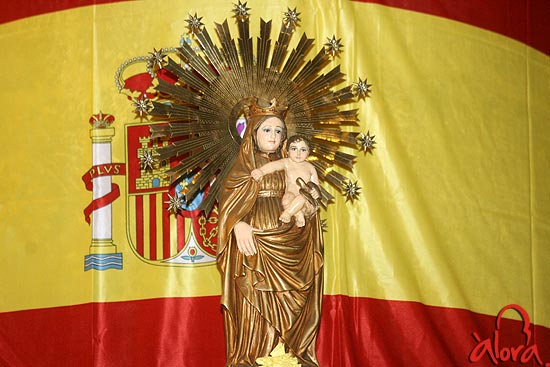
It is also the Day of' 'Nuestra Señora la Santisima Virgen del Pilar' who is the patron virgin of all Spain and the Guardia Civil.


If that wasn't enough reason for a day off work it's the 'Day of the Guardia Civil' too.


The real name of the day is 'La Fiesta Nacionál de España'. which was decided in 1987 as a compromise between those who wanted to celebrate Spain's glorious past and those who wanted to celebrate the new developing democracy.

All it will mean to most people, Spanish and extranjeros alike is that the shops and banks will be shut. We will not even get a chance to go up to the Plaza de  Fuente  Arriba to sing the national anthem as it doesn't have any words.

On the other hand, if you are lucky enough to be invited to the Guardia Civil party up at the 'Cuartel' you are in for a few hours of fun, dancing, drinking and eating. I have been twice. Both times I had too much to drink and made a bit of a spectacle of myself, which is probably why I am no longer invited. It's a great 'do' and a chance to 'network' with all the nobs of the town . The toilets are in the cell block and you can wave at the prisoners as you go for a wee. Another plus is that you are unlikely to be stopped on the country's roads for traffic offences or spot checks as all the Guardia will be at the piss up.
We went with some friends from Rochdale who were here on holiday one year. They had a great time. I had explained that the Guardia used to be very unpopular for their support of Franco's oppression. At the airport I overheard Christine telling someone in the check in queue about it. 'We went to a fabulous party at Gestapo headquarters.'

Have a nice (national) day.

10/10/2012

Tuesday, 9 October 2012

Waiting for the Fagor Man

Waiting for the Fagor Man

Today started as a normal Tuesday morning. Mo went for a hair cut at Cristina's on Calle Atrás and I called in Antonio and Joachim's pescadería to buy seafood for a paella. Then I sat outside cafe Madrugon with a cafe con leche waiting for a call from the Fagor técnico to sort out our water heater. There's no signal on the mobile at home so I was content to wait, sipping my coffee and  reading El Jueves (very funny and very rude indeed) . Then Pablo from the estanco (tobacconist) on the square stopped at my table.`'Have you got the mando for the garage yet? There's one at the ferretería for
you.'


I bought a parking space in a new apartment block in March 2005. Today for the first time I opened the door with my shiny new mando and walked up to my parking space ; number 53. Tomorrow I may even park my car there, though I'm a bit nervous that something will go wrong and my car my be locked in there for ever. From the way things have gone for the last seven years that would be no surprise. There were already two cars parked in there and the lights worked. It's hard to believe. It must be the most expensive parking space in Spain and now worth less than half I paid for it, I'm sure. Just another casualty of the collapse of construction here. In 2005 it looked a good investment until the builder and developer fell out, all the apartments and parking spaces were mortgaged, the developer went bankrupt and the whole place was going to be auctioned off. This may be a green shoot of recovery. My sister has bought a flat in the top square. Boom time is back. Perhaps.

Let's hope it is for Antonio who has opened Bar Ankar Feo in the Plaza Baja. We went in for the first time after viewing our parking space. Cruzcampo on draught and a lovely tapa of pincho de gambas. The bar looks much bigger than when it was called 'Oscar's' and much lighter. Good luck Antonio, who is not at all 'feo' (ugly) but a handsome friendly chap. Apparently all the men in his family are called 'Feo' and have been for some generations. This is quite a common thing here. (so is being called Antonio).  Paco Mañonyo's surname is not Mañonyo either, and his brothers are are called Mañonyo too.

Terry Durham gave us an invitation to the opening of exhibition of work by the 'Artistas Independientes de Álora' on 26th. October at the Casa de Cultura. It's a sort of 'Salon de les Refusés'.
Álora has a good number of resident artists. The exhibition runs from Oct. 20th. until Nov. 16th.

The Fagor téchnician didn't call but the heater has started working. Should I ring and cancel the visit?
If I do it's bound to break down again.

09/10/2012

Friday, 5 October 2012

Scavenging

 
Scavenging


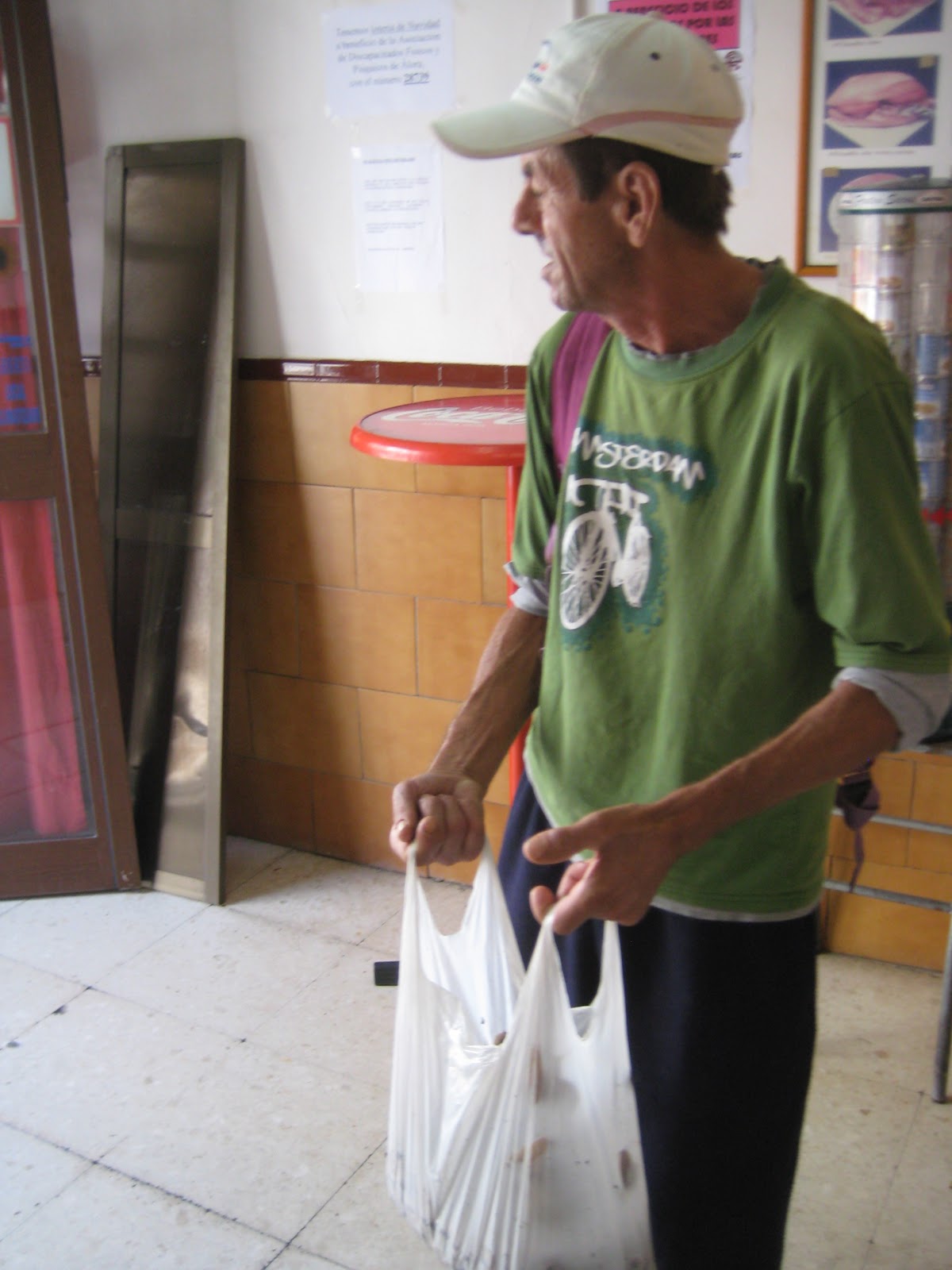
This is Juan. Every morning he goes off into the campo scavenging. He knows where things are and  collects enough in a few hours to buy him drinks for the rest of the day. On a good day he can be pissed by midday. Today he has a bagful of snails and he's trying to sell them in a bar. They are big juicy snails and are plentiful after the floods last week.
Sometimes he has wild asparagus which is either sold in bunches or if there's enough a big fat bunched is raffled.
A day later I bump into Juan again. This time his bag contains olives.
 

I have no idea how he is going to sell a branch with olived attached. Now is the time to harvest the local Manzanilla olives for bottling. They need to be green, firm and as large as possible. This year the processors are paying over 1 euro a kilo. He can't have more than 5 euros worth here.

There are reports that supermarkets in Spain are putting lock on their waste bins because scavenging or 'dumpster diving' is widespread. Youth unemployment is over 50%. Southern Spain is the worst hit. The charity Caritas says that 22 % of Spanish families are living in poverty and more that half a million adults have no income whatsoever.
At the same time, the Spanish government is carrying out further cuts in benefits, employment rights have been removed and national health provision and education are being attacked.

Juan was scavenging when the economy was booming. He doesn't appear to eat much and he lives with his sister. There have been unwritten rights of scavenging in the countryside for many many years, reflecting the historical poverty in Andalucía.

05/10/2012
 

Tuesday, 2 October 2012

An Ugly Development in the Plaza Baja

An Ugly Development in the Plaza Baja
 
I'm not having much success with these photos. This morning we had the first thick mist. Autumn is here and the temperature has dropped to a comfortable 27 degrees. I boiled a kettle of water from the spring on La Canca for a wash, shave and a cup of tea. Then I took two containers down to the fountain on the square to get some water before the crowds gathered. Surprising how you adapt to inconveniences like no water supply. Juannie's mother was filling a container. 'The water's on again' she told me.I hadn't even bothered to check. The water is very 'turbia' (muddy) and not really fit to drink but for once the marginalised population of the Plaza Baja were first in the queue.
They are still looking for the 60 year old man who was swept down the river on Friday. ( the rescue services, not the water queue)
700 houses have been either destroyed or damaged. 1000 (un millar) people have been affected and the cost so far has been estimated at 3 million euros, and that's only premises which were insured. 150 cars were destroyed or damaged.
Our Sopas Perotas Day has been cancelled for next Sunday, which is a shame and seems to serve no purpose at all.
A new bar is due to open in the Plaza Baja tomorrow. It's an old bar. It was previously 'Oscar's' which was opened by an English resident with a view to attracting the ex pat  'bistro' crowd. It didn't.
Now it's called 'Bar Ankar Feo' and will be run by a Perote called Antonio. His nickname is el Feo (the ugly one) and Ankar or Askar or A 'ca is Andaluz for at the place or house of. So, the bar is 'Ugly's Bar' which is a great name I think. Of course, Manolo who runs the bar opposite may have been 'tomando el pelo' (pulling my plonker).  We'll see.

02/10/2012

Monday, 1 October 2012

Alora makes the BBC news

Well, what an eventful few days. What began as a welcome spell of autumn rain turned into a major disaster for Álora. The really heavy rain began at midnight on Thursday and by 6.00am. a storm poured 208 litres per square metre of water an hour on the surrounding area. The River Guadalhorce swelled and swept through Alora flooding the orange groves and the houses of people living on the old river plain. One woman was drowned. 30 houses have been lost. Many owners were not insured and have lost everything. Horses and dogs died as the river burst its banks and the 70 year old bridge across the river was smashed in two.
It is now Monday and the town is still without a water supply. Álora has seen nothing like this in living memory. Apparently the BBC managed to find an English woman 'hotelier' to interview. I have never heard of her  or her 'hotel' , but she expressed her concern for 'the poor people' and her neighbour whose tennis court had been damaged.  Journalism at its best. More photos taken on Friday morning at 9.45am. The train line stayed above water and the 9.55am train to Málaga left the station only 3 minutes late.


 01/10/2012