Thursday, 21 May 2020

There are worse things than not having a haircut for four months. The Wild Man of Borneo Not in Álora is staying alert.


There are worse things than not having a haircut for four months. The Wild Man of Borneo Not in Álora is staying alert.

                         Hyacinthoides non-scripta

When a dramatic disaster happens to you, for example having all your documents and money stolen in North Korea or falling overboard from a cross-channel ferry or being captured by terrorists and held to ransom (it could happen), you can always take some comfort by imagining what a good story it will make to tell to your mates at work , your family and friends when, and if, you survive.

That's the trouble with this Coronavirus / Covid 19 pandemic - all the people you could tell about your experiences at the moment are having the same or similar ones; some more dramatic and disasterous than yours. Even if you have friends on the other side of the world or in Cornwall or even in the Turks and Caicos Islands (Hello loyal readers), you can bet your boots that they've got their own Corona story to tell.
You can't even say to yourself,  'Just wait till I tell my grandchildren about this.', because they're in it too, and you may never see them again anyway.

That's why so many people have started to write a diary - not just to try and get it published and make some money (you have to be a celebrity to try that one) but to be able, if you get through it all alive, to look back on these traumatic times and have a good old laugh. I know I'm looking forward to that.


Having said all that, Mrs. Sánchez and I have had a pretty easy time of it so far. As long as you don't want to go out and can limit your Coronavirus news consumption to only once a day, the minutes, hours, days and weeks just slide by.

We're on Day 59 of lockdown today in the UK, or at least in Scotland and Northern Ireland and possibly Wales, we are. Nobody's really sure what's allowed at the moment in England and by the look of things round here, they never did.
Birmingham, and the Midlands in general are getting a serious biffing from the virus, but sitting here in the expansive luxuriant garden of our winter (and summer) residence on a sunny day with a glass of wine or a cup of tea, it´s easy to forget that we are in the middle of the worst worldwide catastrophe since World War One - you just ask Sir Colonel Tom.


Mind you, some places haven't even got the virus - such as Turkmenistan, Tonga, the Isles of Scilly (in Cornwall) and Ambridge. Bully for them. We booked a holiday in the Isles of Scilly for July but the word is that most Scillonians don't want any visitors from mainland Britain, and who can blame them? not I! - as long as I get my deposit back.

Back in Álora, which we are not, things are starting to get back to ´normal'. Pedro Sánchez (no relation), the Prime Minister of Spain has extended the State of Emergency again but he's introduced 'un horario por etapas' (phased timetable), nothing to do with tapas, which are banned). Movement up through the phases may vary across the regions and within the regions depending on the number of new cases and deaths.

Fase 0, (Phase 1), which began for the whole of Spain on May 4th. was to last a week, during which some businesses could reopen, such as restaurants , but only for food deliveries to the home. You could go out for walks with people from the same household and play 'individual' sports.
 Almuñécar - La Herradura Coronavirus COVID-19, Announcements ...
After being banged up for months on end you can imagine how keen everybody is to get back to normal, especially, as in a few weeks, it's going to be so hot that no-one will want to go out anyway.


Everyone was supposed to move to Fase 1 on March 11th. but Málaga and Granada provinces in Andalucía have been told they have to wait another week. That includes Álora. where they have just moved into Fase 1 this Monday.

Fase 2 starts next Monday 25th.May, but not for Málaga and Álora unless the 'hostelería' sector ( bar, restaurant and hotel owners) can persuade the Junta de Andalucía to reduce their sentence for good behaviour.
A couple of usually unreliable scources have told me that despite the one week delay, some Perotes (Álora people) have given the Junta the 'corte de manga' and are carrying on como si nada. (as if they didn't care). Imagine that!


      Ex-Prime Minister Rajoy giving a corte de manga to the Fraud Squad

It doesn't look as though Mrs.S. and I will be able to get down to Álora before the end of August. Thank goodness we have very good neighbours who are keeping an eye on our garden there. Thanks, Julie and Alan!
Our garden here in Brum has never been better. We realised that we haven't seen it in Spring since 2002! There are plants out there we didn't know we had - bluebells, cornflowers, forget-me-nots, triffids, Jack-by-the hedge, Herb Robert and heartsease and lots of hierbajos pertinaces (stubborn weeds). 
Mrs S. insists that weeds are 'just flowers in the wrong place'.
It took me two weeks to find the right place for them all. They're in black bin bags now, waiting for the day when the queue of cars outside the Council Recycling Centre (tip) goes down a bit.
Our daily walk through Moseley Bog  (It's much better than it sounds) has kept us relatively sane, which is considerably saner than 'Barmy Sue' who lurks  there asking people to introduce their dogs to her hamster.

The bluebells in Moseley Bog have nearly finished now. They were spectacular.

                   A swathe of bluebells in Moseley Bog

The majority of them are 'Spanish Bluebells' which 'the Victorians' brought to Britain, as it was called in those days, as garden plants.

                                  English Bluebells
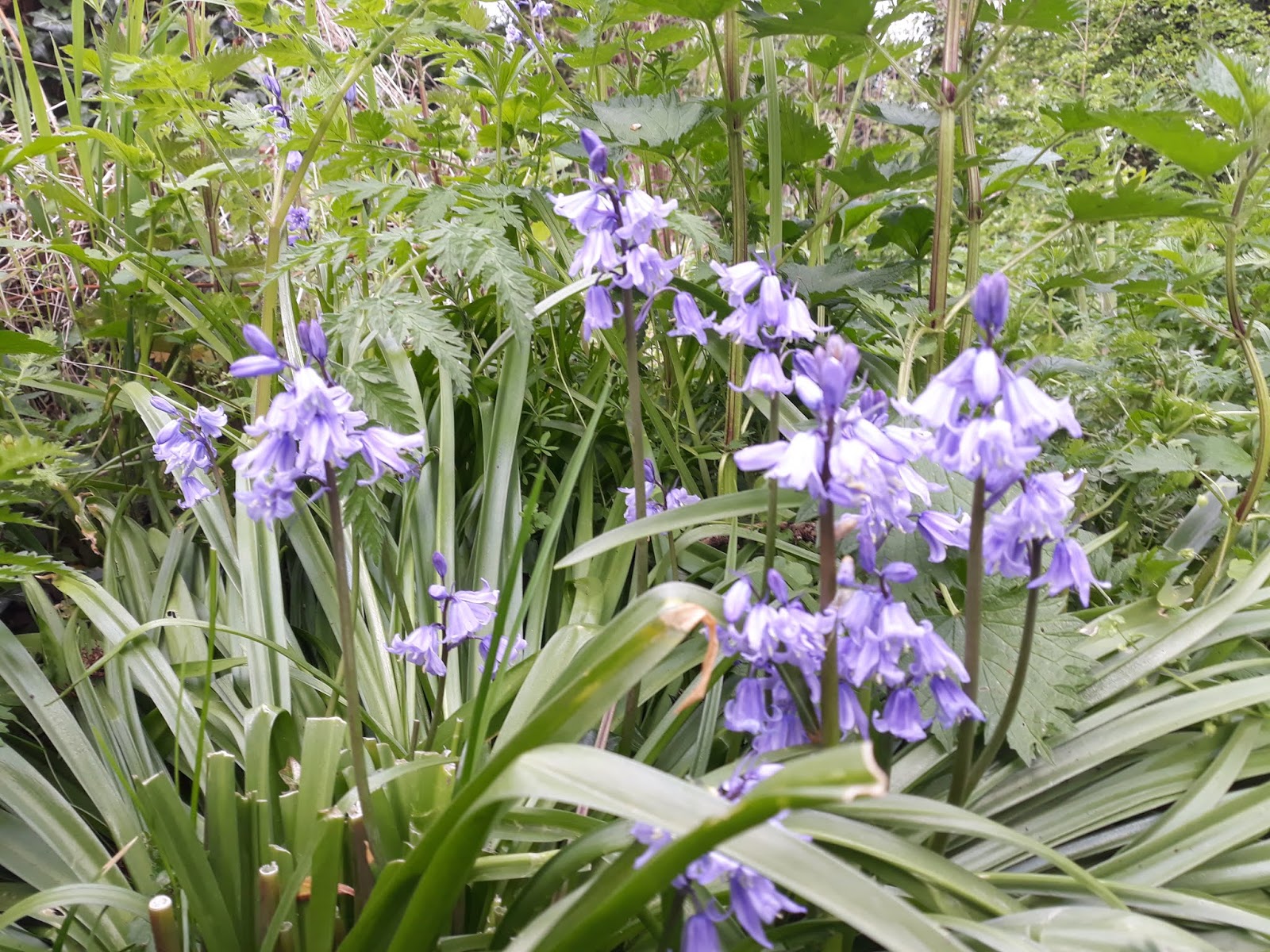
            Spanish Bluebells. Can you spot the difference?


They spread so quickly, along with grey squirrels and cholera, that many prominent people, such as Charles Darwin's cousin , Sir Francis Galton, F. W. Neitzsche, H.G. Wells, G.B. Shaw, W.C. Fields and W.G.Grace started a campaign to stamp them out (literally). 

                                   Types of Bluebell.

They were worried that the immigrant Spanish Bluebell would cross-breed with the native English Bluebell, dilute the race of Bluebells and leave us with a 'mongrel' Bluebell.

A lot of, mainly rich and clever, people in those days were very worried about 'regression to the mean' ( everybody ending up not very clever and not very poor) and the only way to stop this was to stop rich and clever people mating with poor and stupid people - a bit like Spanish (inferior) Bluebells mating with (superior) English Bluebells).

                                       Eugenics

Sir Francis Galton misinterpreted his cousin Charles Darwin's theories about 'natural selection' and invented 'Eugenics', which proposed selective breeding of humans and led to the idea of a master race.

'You must have a Eugenic Certificate'


Eugenics became very popular in the USA and resulted many years later in Donald Trump.

Galton's ideas were set to music by W.R. Wagner and used by A. Hitler to  justify the mass murder of millions of people.

Anyway, the future looked bleak for the poor old Spanish Bluebell until Percy Pickles, a young Australian backpacker, earning a few pounds as a research assistent at Cambridge University stumbled on the discovery that the genetic makeup of the Spanish Bluebell is weak and so reproduction between the two plants was impossible. Phew!
The Spanish Bluebell was saved. They don't grow in Central and Southern Spain, though.

If you are still awake you probably think I've gone 'stir crazy' and you would be right. I could be out in the garden right now doing a bit of weeding if I didn't owe it to you all to keep producing these entertaining vignettes on a regular basis. I do hope that none of you has died from the coronavirus or from that last poem I wrote. No more of those - I've moved on from that phase of lockdown lunacy.


Bar news

We are missing Álora's bars.

                                     Oofty Goofty


Juanito Sánchez (AKA The Wild Man of Borneo)
May 21st. 2020


Monday, 20 April 2020

Life in Lockdown. House Arrest Hallucinations


Monday, 23 September 2013


Nobody Expects the Spanish Inquisition


Yesterday we went to Casarabonela, a small picturesque town in the Sierra de las Nieves about 20 km. from Álora.


                                                          Casarabonela

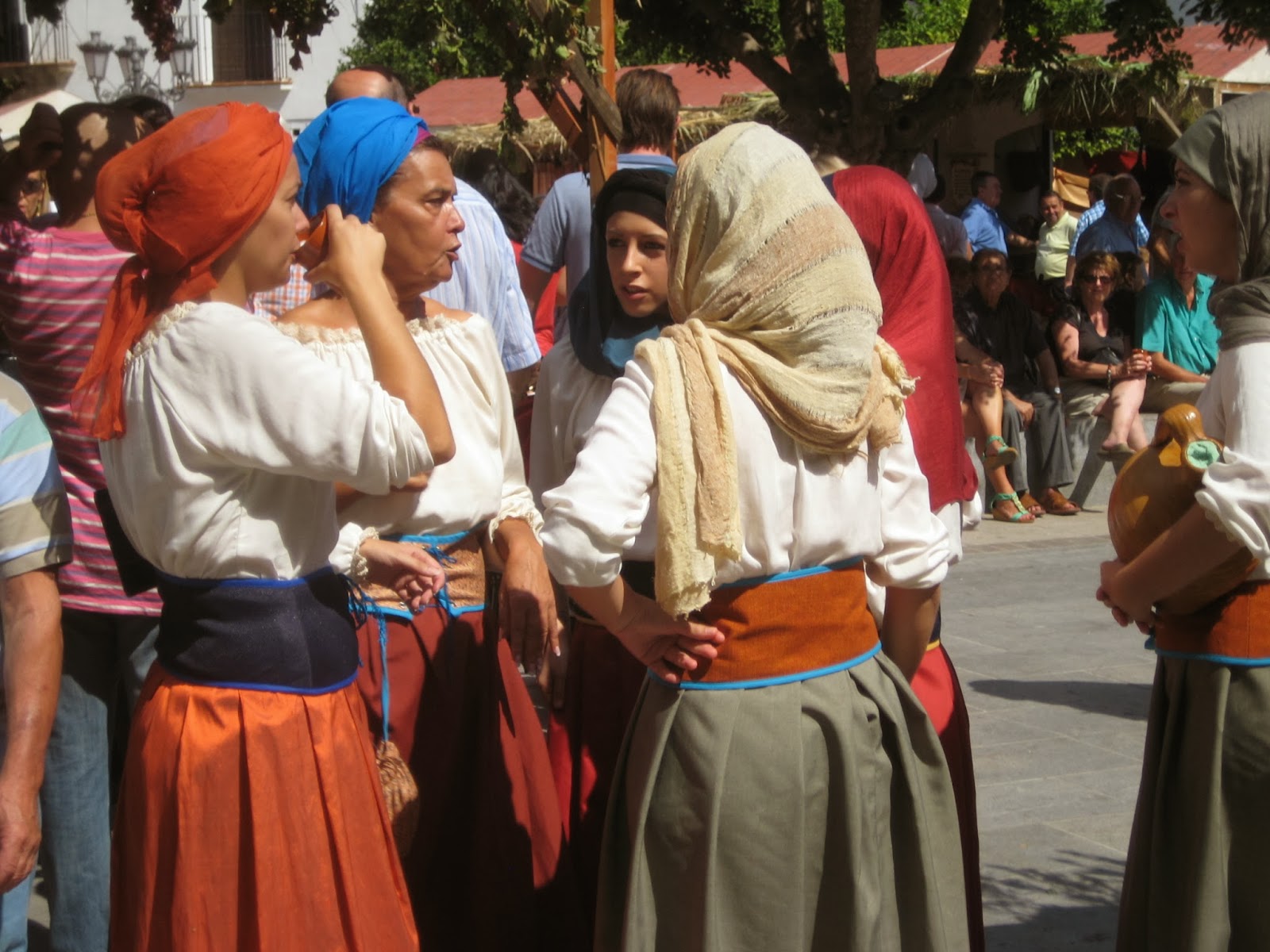
 This weekend they are having a Recreación Histórica 2013 Inquisición en Casarabonela 1560. (A 2013 historic recreation of the Inquisition in Casarabonela). 300 locals are dressing up in period costumes and the town square has been converted into an espacio escénico to commemorate the arrival of the notorious and dreaded Spanish Inquisition in the town in 1560 on the hunt for heretics, blasphemers, bigamists, horse smugglers, freemasons , moriscos, crypto- jews, witches, sodomites, solicitors and foreigners. If the espacio escénico is authentic, the inquisitors would have been pleased to find in the town square; a bread shop, a cheese shop, six bars, an olive oil shop, a tea shop, a small prison and a tourist information office.


On our arrival a young lad on crutches (not a costume item as it turned out) led us to a shed where I was interrogated by a shifty fellow in a big hat who asked my name (I told him 'Pedro' - a lie) and then I  was invited to stand in a cell. Apparently I was being accused of one of the above indiscretions but none was specified. This was fun and a good start to the afternoon until it became clear that the lad was demanding money and wouldn't let me out until I gave him 1 maravedí  which  turns out to be about 1€ in new money. I told him to keep the change and was given my certificate of release by el inquisidor.


                                                            the view from my cell


                                                      my release papers


Mrs. Sanchez reckons I got off lightly considering the charges.

Everyone was having a jolly old time drinking local beer and eating local tapas but mostly taking photos with their phones, tablets and cameras. Most of the locals were either dressed as moriscos or  16th. century Christians except for a rather glamorous young woman who had clearly mistranslated the poster and looked liked Edith Crawley off Downton Abbey. She was with a nice young chap in bloomers and high heels (circa 1475. The White Queen?) who wouldn't have lasted 5 minutes if Torquemada had spotted him click - clacking across the cobbles. The same applies to a German Jehovah's  Witness Estate Agent I spotted. (Got him on three counts at least).
I approached three pretty morisco girls chatting and smoking on the church steps. I asked the prettiest to explain something in my programme but  her chewing gum got stuck on  it and the moment was lost.  How we all laughed!


             Inquisitor asking tourist if he is a sodomite, and if not could he point one out, please.


"Watch out if they offer you a spot of relaxation, girls"


At a given signal the Escenification história. Escena 6 began. Some women had an argument  and an old lady was marched away by a couple of priests and four burly soldiers. I bought some cheese and we went home.


The weekend of events in Casarabonela is another of the village initiatives which have appeared all over Málaga Province. Some have been runnng for a few years and they are all a way of attracting tourism (mainly from other towns and villages) and so generating income. Álora has it's 'Sopas Perotas Day' (October 5th.). Almogía has 'The Day of the Almonds', Alozaina has 'The Day of the Olives', El Burgo 'The Bandaleros' and  Los Bobos has 'The Day of the Village Idiot'. Good luck to them all I say.

The Spanish Inquisition really did come to Casarabonela in 1560. They were looking for Moriscos (moors who had converted from Islam to Christianity.) and in 1560 Casarabonela was full of them.

Ferdinand and Isabela (Los Reyes Católicos) finally conquered Spain with the fall of Granada in 1492. At that time moors and Christians had lived reasonably well together down here but Ferdinand and Isabela had  already expelled Jews (about 40,000) who would not convert to Christianity from Spain by 'The Alhambra Decree' (1492) (finally rescinded in 1968!)

Moors or arabic people had lived in Andalucía since the invasion in 711 but F&A wanted to get rid of them all so they set up The Tribunal of The Holy Office of the Inquisition in 1478 which set about ethnically cleansing Spain and later its colonies.


                            The Seal of the Spanish Tribunal


The original Inquisition had been set up by the papacy in the 12th. century to stamp out heresy in France. The Spanish version was mostly aimed at Jews and Moors. There weren't many heretics in Spain as Protestantism never caught on, but any of the above would do as long as they had a healthy bank balance ; the Spanish Inquisition had no budget and depended on confiscation of money, land and property. "If they do not burn we do not eat". Its most famous 'Grand Inquisitor' was Tomás de Torquemada, a Dominican friar from Valladolíd who looks a bit of a bruiser. There is a posh hotel nearly named after him in Benalmádena.
 Between 1560 and 1571 82% of those accused by the Spanish Inquisition were Moriscos.


                                                                Torquemada

Anyone seems to have been able to denounce a 'crypto-jew' or 'false morisco'. Suspicion could fall on you if there was no smoke from your chimney on Saturday, you bought meat from a 'converted' morisco or you ate a lot of vegetables. Everybody ate as much pork product as they could when anyone was looking.

This is how it worked.
Quite unexpectedly the Spanish Inquisition would arrive at your town to hear accusations. Everyone would be given 40 days 'to relieve their consciences' and/or accuse others of some transgressions. All accusations were anonymous and the accused were not told why they were being arrested. Sounds a bit unfair so far doesn't it?


The garrucha and the rack

Then came detention in a secret prison in the nearest main Inquisition centre for up to 2 years while all your property was confiscated and you were 'encouraged' to make a clean breast of it. A trial  then took place which would often involve torture. It may be a fine point but they say that torture was not used as a punishment but only as a means of interrogation. So that's all right then.
The three most popular tortures were:
the garrucha where the 'defendant' was hung by his/her wrists and periodically dropped short distances. Sometimes weights were attached to the feet. This tended to dislocate the joints a bit.  
The potro (rack) was stretching things a bit far, too, although some participants found it quite therapeutic in the initial stages. (see also osteopathy.)
The toca involved sticking a cloth in the mouth of the interrogee and pouring water on it, giving the impression of drowning (see also waterboarding).

I think they all sound unpleasant.


                            A  Wacky Warehouse circa 1560

Sentences ranged from acquitted (rare) to relaxation (ha ha wait for it!).

In between were:

penanced : guilty but made to work on the galleys (average survival rate 5 years) or exiled etc.
reconciled : long jail sentence, flogging, whipping, confiscation of property, chinese burn etc.

Relaxation meant that you were turned over to the local council for burning at the stake unless you  begged for mercy and then you might get off with a garrotting. The church didn't carry out executions. They were, after all, Christian gentlemen in Holy Orders. Some people were convicted in their absence and burned in effigy. This sounds a good deal better than the other outcomes and could have avoided all that stretching and drowning, not to mention burning. My choice every time.

The executions took place at an auto de fé which was a bit like an Olympic Closing Ceremony held in a McDonald's.  Estimates of people burned in person in Spain vary from 3,000 to 28,450 depending on who you ask and how much Cruzcampo they have necked.
As Leonard Bernstein said in his musical version of 'Candide'; It's a lovely day for burning and watching people fry".


                    An auto de fé in Valladolid 21st. May 1559

As for the poor old moriscos of Casarabonela, the ones who survived the 1560 inquisition were all ethnically cleansed in  1609 when hundreds of thousands of them were expelled from Spain following the Morisco Rebellion of 1568. Casarabonela was repopulated by people from Seville with promises of free housing, as much callos as they could eat and a bit of street theatre.

The Spanish Inquisition was abolished in 1834 although General Franco wanted to bring it back.

September 23rd. 2013


It doesn't seem that long since it began.

The season moved from winter into spring.

We watched it come. No leadership,no plan.

No ventilators, tests or anything.

Behind her rainbow window, Ruthie stands.

She can't go out. Her school has been closed down.

Just, 'herd immunity'. 'Now wash your hands!'

A bus goes by. There's no-one going to town.

They closed the local park, too, yesterday.

'The weather's been so good. 'It's such a shame'

'Just kids who broke the rules, I'll bet.' they say.

'They didn't keep their distance - end of game'.

And every hour of every day and night,

They're fighting for our lives there, out of sight.
 
I hope I'll have cheered up a bit before the next edition.

A big cheer for all health workers, firemen, care workers and for everybody risking their lives for us.

Now back to the jigsaw puzzle. 

Juanito Sánchez April 20th. 2020

Saturday, 28 March 2020

'May you live in interesting times'


"May You Live In Interesting Times"
  太平, 
(Better to be a dog during  peacetime than a human in times of war)


March 28th. 2020. The Spanish Legión arrive in Álora 
for Semana Santa.

Following Spain´s declaration of  'A State of Alarm', all normal activities in Álora have been cancelled until further notice. On March 14th. the ayuntamiento announced an almost total 'lockdown'. Except for essential activities, such as shopping for food or medical supplies, going to and from work and helping people in need, everyone must stay indoors. The police are stopping cars and pedestrians and demanding a reason for being outside. At night the pavements and walls of the main streets are being washed down with disinfectant. Álora is taking its responsibilities in the fight against Coronavirus very seriously indeed.

Semanta Santa (Holy Week) begins a week on Sunday and Domingo Ramos (Palm Sunday) is usually marked by the first processions through Álora's streets. The climax of the week happens on Viernes Santo (Good Friday) when the two main hermandades (brotherhoods) parade their tronos. (thrones or floats as we might call them) They are ; El Señor de las Torres and La Virgen de Dolores Coronada. Both of these hermadades pay for military escorts which are spectacular and very popular.

 El Señor de las Torres
La Virgen de Dolores Coronada  

El Señor is escorted by soldiers from the Brigada de Paracaidistas BRIPAC (paratroopers) who do a lot of impressive juggling of their assault rifles along the way. La Virgen de Dolores has La Legión for company.

Although the paracaidistas look pretty hard, and very dangerous when they start chucking those big guns around. (so far nobody has been seriously injured), the Legión, with their motto ´Viva la Muerte' ('Long live death!') and their history of brutally suppressing the Moroccan arabs and Spanish Republicans, are in a different league. They are really scary.


Los Paracaidistas


La Legión
It´s always puzzled me why the military have become so essential to Easter. No self-respecting parade would be seen without a few soldiers in uniform.
Anyway, even though Semana Santa will not be taking place this year, the Legión can't keep away. (only joking chaps). They are here to help the Policía (local police) and Guardia Civil to enforce the restrictions on movement. I wouldn't argue with that lot!
From what I am hearing, people in Álora, perotes and extranjeros alike, understand how important it is to stay indoors until this wave of disease peaks and eventually fades away.
Mrs. Sánchez and I were due to be back in Álora this week. We hope we shall be able to return ASAP.  We really miss everyone.

Hats off to 'Arthur', who has been in England for several weeks caring for an elderly aunt. His 'better half' has had to cope on her own, self-isolated in Álora. As soon as he was able to he snapped up seat on a rare flight from Gatwick to Málaga. Have you met his Auntie Margaret?
That's what love can do!  I hope she fumigates him before she let's him through the door.

There's no doubt that Spain is going through a terrible period now and all the indications are that here, in Britain, we are in for a rough ride too. 
Restrictions here on mixing socially have taken place very  slowly.
We've been getting mixed messages from our government.

In Birmingham, where we still are, in our 'winter residence, confirmed cases of Covid-19 and deaths are increasing at an alarming rate and some people, even those in 'vulnerable' groups, are still ignoring the 'advice' on 'social distancing'.

They should ship a platoon of La Legión over here with a couple of those Humvees to focus people's minds

Mrs.Sánchez and I are staying in, except for taking Monty out for a run where hardly anyone goes. We are all allowed one walk a day. We are lucky to have someone to shop for us.

By popular demand I've rote another topical pome.
 

                        Three Days into Lockdown

There’s no-one going down our road. Who’d dare to disobey?
They’re saving their allowance for later in the day.
We’re all stocked up with toilet rolls and anti-septic spray
We’re three days into lockdown now and indoors we must stay.

We’re getting daily briefings too, with government commands
Which basically are saying, ‘Stay in and wash your hands’.
They’ve got a team of ‘modelers’ who think up all the plans
With graphs and calculations that no-one understands.

We’ve set up a ‘support group’ here. It´s on the Internet.
I gave a young lad thirty quid. No sign of groceries yet.
There’s lots of tips and sound advice on how to manage debt.
We’re all good friends and neighbours now, although we’ve never met.

I’m getting tired of pasta now. I’m getting sick of rice.
I bought some eggs two weeks ago and they don’t smell too nice.
The sprouts and cauliflowers went brown. We’ve had to throw them out.
We’re three days into lockdown now and nobody’s about.

No Bar News. No Bars.

Don't forget to put your clocks forward tonight.


Juanito Sánchez  March 28th. 2020