Saturday, 15 July 2017

Man not in Álora goes shopping and almost clears a bus.

Man not in Álora goes shopping and almost clears a bus.


                                                         Craster Kippers

Yesterday I went out to buy two dog whistles (two dogs, so two dog whistles, right?). After reading my previous blog I decided the best place to go was J. Hudson & Co. (Whistles) Ltd. which by a fortunate co-incidence has its premises in  Birmingham where Mrs. Sánchez and I are 'veraneando' (summering) at the moment. I was hoping to combine my trip to Britain's 'Second City' centre with a visit to Birmingham's world famous Indoor Market to buy a watch strap, a pair of Craster kippers and some pork scratchings. Also a neighbour of ours who manages a sunglasses shop had implied that he could 'fix me up' with a pair of designer frames. A busy day ahead, then.


How I imagine I will look in my new  Ray-bans


Unless you are a vegetarian, never go into Birmingham Indoor Market with full pockets and an empty stomach. 
The sunglasses tip turned out to be "to' pa' na' " (todo para nada in Perote talk) (all in vain) ; my neighbour wasn't at work that day, so, with  Craster Kippers, watch strap and pork scratchings in the bag, I flashed my Centro Concessionary Pass at the fat layabout at the Moor Street Station barrier and boarded the next train for The Jewellery Quarter. It was a warm July afternoon.


 Birmingham's world famous Jewellery Quarter.


The Jewellery Quarter is in the Hockley district of Birmingham and was a bit run down for a time even though for 250 years it has been a thriving centre for jewellery manufacturers, jewellery shops, bullion dealers, watchmakers and repairers, you name it.The Birmingham Royal Mint is just down the road. That venerable establishment  was banging out 1€ and 2€ coins until 2013.
These days The Quarter  has bars, restaurants, a Museum of the Jewellery Quarter, a Pen Museum, (see blog  9/3/14) and a Coffin Museum (they made coffins for Joseph Chamberlain, Winston Churchill and the Queen Mother).

I was looking for J. Hudson & Co. (Whistles) Ltd. on Barr Street. I had it on Google maps so I turned left after leaving 'Jewellery Quarter' station, down Vyse Street and found Barr Street which turned out to be a very long road full of fringe businesses selling mobile phone paraphernalia, 'solutions' and boarded up warehouses. After walking for 15 minutes in the wrong direction and another 15 back, Barr Street ran out at the A4540 internal bypass. After an uphill walk to a footbridge and another 20 footslogging minutes I found the rest of Barr Street and located  J. Hudson & Co (Whistles) Ltd. just up from Ced's Car Alarms and Porky's Cafe.(Mmmm.) . By this time the kippers were making their presence felt.


 244 Barr Street, Hockley.


They are obviously not expecting passing trade. You could call it one of Birmingham's hidden treasures. The building looked abandoned, like many of those in this god forsaken backwater but I rang a rusty bell and a young male voice asked me what my business might be.
'I wish to buy a whistle or two.'
'Wait there I'll be right down'

The door was opened by a freshed -faced bespectacled youth who led me up an old, creaky wooden staircase with faded tiled walls to the 'Whistle Room'. Birmingham ought to adopt it as 'The Whistle Museum' (and it probably will as my new best pal, Carl Rice, Lord Mayor of Birmingham reads this blog (I think)). 
All available wall space contained cabinets full of J. Hudson & Co.(Whistles) Ltd. products, past and present, including the world famous ACME range of megaphones, bird callers, bosun's whistles, reed horns, police and infantry whistles and, of course, that world famous 'teachers' friend', the 'ACME Thunderer', immortalised by the world famous Liverpool Beat Poet,  Roger McGough.

 'He Who Owns the Whistle Rules the World'
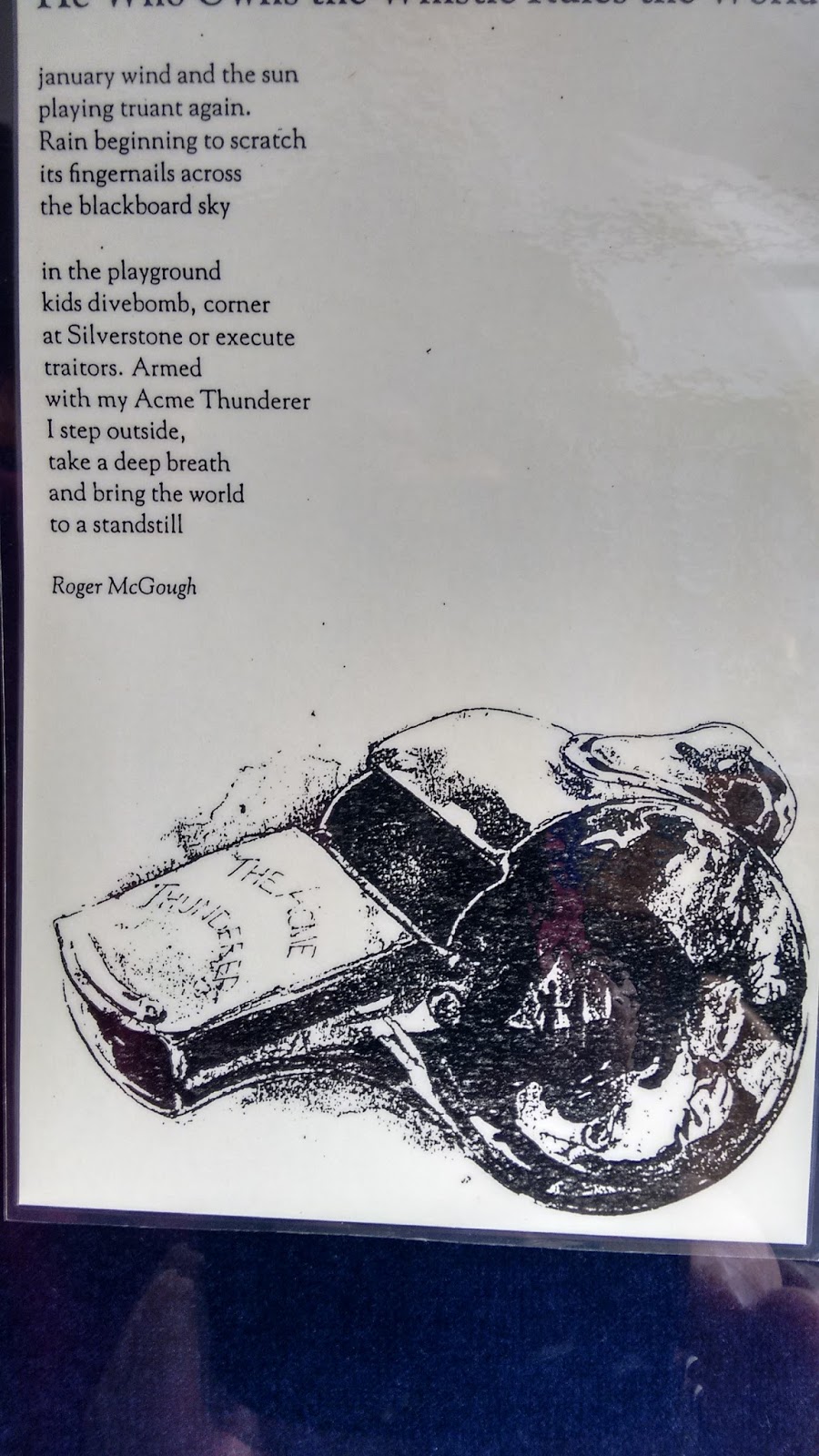


The Acme Thunderer.

 I had one myself during my brief but eventful career at Christ's Church County Primary School, Beswick, Manchester. 
(If any ex pupils read this, perhaps in Russia or the Turks and Caicos Islands, please resist the urge to contact or pester me in any way or I will take out a court injunction against you. So watch it!))


I told the enthusiastic George (Pepys!) (who reminded me of the the lad, Geoffrey, assistant to Hetty Wainthropp in the very popular TV detective series , 'Hetty Wainthropp Investigates, which can still be seen on the Drama channel), that I was looking for two dog whistles as I had two dogs, one with perfect hearing and one with a moderate to severe bilateral hearing loss. He performed a number of facial contortions indicating deep thought and replied,

'I think what you want is not 'two dog whistles' but a 'two dog whistle' and we have just the thing. It will turn out much cheaper than buying two dog whistles. What colour did you have in mind?'

'I think yellow'.

So off he went into the bowels of 244 Barr Street. (he may have been the only person in the building for all I know) and returned with two yellow plastic whistles. One played at a lower pitch than the other. I chose the higher pitched instrument as it is common knowledge that dogs hear higher pitched sounds than humans.

'The deaf dog will be able to hear this and the other will hear any whistle. So you only need one', he explained. 

'I'll take two'. 

Such wisdom and in one so young!


 The Acme 210.5 dog whistle.

"I'll take two!"


George told me he had been working there for  four years, starting as an apprentice in the warehouse. He really liked his job and was happy to answer my questions and let me take some photos.


The Titanic Display. Acme Thunderers were used to marshall people into the lifeboats as the Titanic was sinking. In 1991 an original one was sold for £3100.


Hudson's make a wide range of bird and animal attractors 'for the ornithologist, game enthusiast and country folk'. 'Cuckoo', 'nightingale' and 'duck call' all seem reasonable but who would want 'Pig grunt and squeal' or 'rabbit squeal'? George said there wasn't much call for the pig squeal caller these days but the 'sheep bleat' is still popular in Wales.


George Pepys posing in the imposing portal of J Hudson & Co (Whistles) Ltd.
244 Barr Street, Birmingham. 


 If that wasn't enough excitement for one day, the kippers and I passed by Porky's Cafe and headed back up to take the train back home. Perhaps it was all the excitement or the heady, smoky, fishy aroma emanating from my plastic carrier bag but I ended up on the wrong train.
There appeared to be a sigh of relief from the other passengers as I jumped out at Solihull station.
I called Mrs Sánchez, who is the 'go to' person on all matters of public transport and she advised me to take a 76, 6 or 5 bus 'if I could find the stop'. 
Luckily my Centro Concessionary Pass is good on the buses too!

I found the stop and got on the first number six.  No double seats empty. I sat next to a very presentable Solihull lady who got wind of my kippers immediately, as we say up north.
I was grateful for a call from Mrs. S. to see how I was getting on as she needed the car and I'd parked it at the station. It took the heat off me (and the kippers) a bit, and I was saved from further embarrassment when two burly lady bus inspectors boarded the bus. I flashed my pass confidently but the chap in the seat in front got nabbed. No ticket.
Things got nasty and escalated. 

'This bus is not moving till you get off!'

'I pay your wages to bully me. I have epilepsy. I am disabled. I not moving.' (He was a bit foreign).

' Leave the bus, sir, or we will evacuate the bus and transfer the passengers to another bus and wait for the police.'

You could tell that the other passengers were hoping for the evacuation option as the kippers, by this time, were half cooked.

After a seemingly interminable stand-off, they tossed him off. The poor chap took the walk of shame down the aisle of the bus and got off. I think the kippers broke his will.

The lady next to me got off two stops later.

What an exciting day. We had the kippers with scrambled egg this morning. Delicious!


This week's competition

How many whistles/harkers/megaphones can you see in this poodle picture?

Answers, as usual with the  £10 administration fee to Sánchez and Sánchez. Box 311. Alora, Malaga.


Juanito Sánchez July 14th. 2017
 

Monday, 29 May 2017

Whistle Blowers, Sanguineous Sausage and Revolting Catalans.


Whistle blowers, sanguineous sausage and revolting Catalans


Antes que nada (First of all) I must offer my apologies to Julian Clary and his lawyers for a mistake I made in the last edition of this venerable but humble organ.
King José 1st. of Spain (Joseph Bonaparte) was not really married to Mr. J. Clary, star of the stage and witty radio panellist . His wife was, in fact,  Julie Clary who was born nearly two hundred years before the popular entertainer and animal lover.

                                              
                                Julie Clary Bonaparte ( Born Julie Clary in 1771; died in 1845)


                                                Julian Clary, popular entertainer.

You've got to so careful these days when you write an extremely popular and informative blog like this. A simple typing error can get you into all kinds of trouble.I hope that this will be the end of the matter.

I missed the Eurovision Song Contest again this year so I missed Great Britain's sucess in scoring some points. Here in Álora not everyone was rooting for the Spanish entry, 'Do it for Your Lover', sung by Manel Navarro Quesada, a Catalán 'teen idol' who allegedly (careful Juanito) only qualified as Spain's entry by rigging the votes. Manel's reply to the accusations of skullduggery was a 'corte de mangas' to the studio audience who were booing and hissing him. 

Here's Manel giving the corte de mangas to the audience.

Here he is giving a victory 'V' sign at the Eurovision  final.


This was just before for he sang a gallo (bum note) The judges responded by returning the V sign and giving him 'nil points'.
Spain came last. Manel is now known as 'El gallo' (The Cockerel/ Bum Note).

 It doesn't matter to millions of Spaniards because he's Catalan and therefore to them,'not Spanish'. That's why his name is 'misspelt'. There's a lot of animosity towards Cataluña because it is trying to become independent from Spain and because  Barcelona FC.  keeps beating 'real Spanish football teams' like Real Madrid and Atletico Madrid. (sometimes)

                                                Catalan flag (blue version)

There was a Catalan referendum in  2014 which resulted in 88% of the 35% of the Catalan population who could bother to vote voting for independence. This was a non- binding referendum (why didn't Cameron do that?), so when the Catalan government announced it was going to declare independence anyway, Spanish Prime Minister Mariano Rajoy said 'No way José!' (¡Ni hablar de la peluca, José!) even though the Catalan president was called Artur (Arthur) Mas. Mas is now banned from holding any public office for two years. The new Catalan President, Carles Puigdemont is a big fan of Nicola Sturgeon and together they have formed a new 'We Want Independence' club. 

                                         Nicola Sturgeon and Artur (Arthur) Mas

 Members so far include the USA, The Turks and Caicos Islands, Yorkshire and London. 


Progress with Pretty Boy George (Monty)

The 'Man in Álora' office has been inundated with enquiries about the Sánchez Spaniel, Monty, now 5 months old, and in particular about how he is finding life in Álora.


Well, apart from the heat and the oily food he has voiced no complaints so far. All the local strays and 'homies' of the Plaza Baja presume he is 'son a 'Bro' Tomás, innit. (Tommy's son)  and so they're scared of even 'sneak disssing' him, let alone 'getting crunk wid him' as they say round here. 


                          Plaza Baja  perros showing respect for 'el Niño de Bro' Tomás '

The only sign of disrespect was up at the castle when a crazy macho (male) Shar Pei  'went postal' with Bro Tomás. Tommy flashed his Perote snarl and snap and the ugliest dog in the world 'did one'. Monty was well impressed, I can tell you.

His training programme se dió en un hueso ( hit a snag) a couple of weeks ago when Mrs. Sánchez realised she can't whistle. Like most problems these days it was solved by Dr. Google who suggested a dog training whistle. Apparently the only whistle any self respecting canine will respond to is an 'ACME 210.5'.

                                                            The ACME 210.5

Contrary to popular opinion, a dog whistle doesn't have to be inaudible to the human ear -  as long as the dog can hear it. Dogs can perceive a far higher range of high pitched sounds than humans but,  how do you know  a silent whistle's working if you can't hear it?

                          A British bobby blowing a  'ACME Metropolitan' police whistle

During my brief but eventful career as a teacher I was obliged to be 'on playground duty' every few days. The only compulsory equipment for this thankless sacrifice of my morning coffee break was an Acme Thunderer whistle, as essential a piece of teacher kit as a police whistle was to a bobby before they invented walkie-talkies and a referees whistle was before.....oh, they still use one and it's usually the 60.5 model.

Acme Thunderer 60.5 (200 million sold by year 2000)


'A primary school has introduced a ban on whistles on the grounds that the “aggressive” noise can scare children.
St Monica’s Catholic Primary School in Milton Keynes has said instead of using whistles at the end of playtime, staff must raise their hands to tell pupils when it’s time to stop.
The ban was revealed by Pamela Cunningham, a teaching assistant at the school. In a letter to Country Life magazine, she said she still keeps her hand-carved whistle in her pocket “just in case” the children don’t spot her hand in an emergency.
Alan Smithers, a professor at Buckingham University, has described the ban as "crazy".
He told The Sunday Times: “We have become extraordinarily oversensitive. Does this means children are not going to be able to play football and hockey because the referees use whistles? 
“What about fire alarms? Sharp noises are very good signals. This seems crazy to me.”
The decision has also provoked a reaction on social media, with Twitter users describing the ban as “idiotic” and “ridiculous”. John Roninson, who works for a stage lighting company in Huddersfield, wrote: “Some mornings you wake up and wonder if you're in a parallel universe.”'

The Independent. 22nd. May 2016
' 'Hand carved whistle??? Not an ACME Thunderer,then.


                                       World War 1 Hudson Whistle, dated 1915.
Anyway, all these ACME whistles and many more are made by J Hudson & Co. of 244 Barr Street, Birmingham They have been making whistles there since1883 when Joseph Hudson discovered that you could make a more powerful sound by putting a pea in the whistle.
They still employ 100 workers, make over 5 million whistles a year in 93 different shapes and sizes and export to 119 countries.

It was the sound of a J. Hudson whistle that sent thousands of British soldiers 'over the top' to die pointless deaths in World War 1 but  their best seller was the 'Metropolitan' which was issued to London's policemen instead of 'rattles'.
They saved a few lives too. 
Today Hudson's Tornado 2000 is 'the most powerful whistle in the world' and can reach 122 decibels which is very loud.
ACME TORNADO 2000

 Good News From Álora
Tenacious followers of this honourable publication may remember the tragic loss of water at Alora's Roman Fountain on La Canca. Mrs. S and I used to obtain all our drinking water there as did hundreds of Perotes. Rumours were rife about what had caused the abrupt termination of supply. The appearance of a big commercial citrus fruit plantation nearby was linked by some  very cynical commentators to the 'sequía' (drought)
Now we have water again!
                                                                  Last week

                                                                  Last year
Too late for us. We had a very expensive water purifier installed last year so we can use the town's tap water.
Congratulations to all involved in restoring the flow.

Noticias sobre las morcillas  (Black pudding news) (Skip this, Clive).
For black pudding enthusiasts I would like to recommend El Bar Nuevo in Casarabonela for its outstanding morcilla.
    Only a few picturesque kilometres away from Álora, Casarabonela ('Bonela' to residents and frequent visitors) is home to a morcilla casera (home made black pudding) which is de puta madre (the dog's bollocks). It is quite dfferent from the morcillas I have tucked into around Málaga and nothing like the famous morcilla de Burgos which has been my favourite until now. This scrumptious sanguineous sausage is the closest I have come in Spain to the world famous Lancashire liplickingful  Bury Black Pudding.
                        Morcilla casera. El Bar Nuevo de Casarabonela (and chips)

You can buy this porcine delight at either of the two carnicerías (butcher's) in 'Bonela. The  nearest to Álora is just through the town archway on the left. Mmmmmm.
¡Qué aproveche!
Juanito Sánchez.  May 29th. 2017


Wednesday, 10 May 2017

Joe Bottle and why there are no old masters in Spain.

   
                           Pepe Botella. (Joe Bottle)  King José 1st. of Spain.


                         'Everyone to  their own fate. Yours is to be drunk until you die'


There's been a lot of talk about 'fake news' recently so I'd like take this opportunity to reassure all my loyal readers that nothing you will ever read here is in any way 'news'.
I'm sorry if any of my new 138 readers in South Korea are non-plussed by that statement but I expect the 190 Russians who have also 'viewed my page' yesterday will know what I mean. Don't ask me.......I've no idea.
I'm also delighted to report that the readership of this humble organ in The Turks and Caicos Islands has increased from 1 to 28 since those beautiful and unspoiled paradise tax havens got a mention. 

The big news at the moment in Álora is the visit to our beautiful historic  pueblo of 17 school students from France.

Here they are being welcomed at the Ayuntamiento (town hall) by our Alcaldesa Accidental (Accidental Mayor), Sonia Ramos and their Spanish counterparts.They will be staying with Perote (Aloranean) families for a week and will get the chance to visit Córdoba, walk the now world famous Caminito del Rey, which is just up the road, and tuck in to our signature dish, Sopas Perotas. Mmm. Welcome to you all.

Considering that France and Spain are neighbours we don't see many French people around here, either as residents or on holiday. It's not that far away after all. 

I asked the owner of my favorite bar for his opinion about the 'Gabachos' (French) and he was very negative. My old friend Antonio Martos didn't like the French either. Apparently French farmers are always attacking Spanish lorries as they head to Northern Europe with grapes, avocados,melons, oranges, lemons and wine. That's upset a few people, naturally, but  the real reason for this perpetual traditional trans-Pyrenean petulance goes back two hundred years and to what Spaniards call La Guerra de la Independencia Española (1808-1814)(The Spanish War of Independence) and the British call 'The Peninsular War' (starring Sean Bean). 
And the Spanish blame everything on 'Joe Bottle', Napoleon's brother.

                                                             Napoleon Bonaparte

Napoleon Bonaparte was famous for going all over Europe and into Africa bashing and biffing everybody he came across, making them learn French and buy onions. He was also very fond of robbing the countries he biffed and bashed of their best works of art so that he could fill his new Art Gallery (The Louvre) with his loot as well as portraits of himself like the one above which first attracted  the lovely ('not tonight') Josephine to him.
His elder brother, Joseph was a peaceful, cultured, well meaning sort of a  chap who was fond of reading, gardening,  collecting butterflies, stamps and paintings until his brother spoilt everything for him by making him king of the places he had biffed and bashed.

                                         Joseph Bonaparte (a reluctant despot)

First he was sent in 1806 to be King of Naples and the Two Sicilies where he got on quite well with the locals who had just got rid of a really nasty king. Joseph and his wife Julian Clary got on quietly with the job, Joseph with his gardening and art collection and Julian with her work with orphans and fallen women. Things seemed to be going well until his brother decided to biff the Spanish and invaded Spain, kicking out King Ferdinand Vll. Napoleon told his brother to go to Spain and grab all the loot, especially pictures, he could get his hands on and made him King José 1st. of Spain.

The Spaniards were very cross. They regarded the French as atheists and foreigners who deserved no mercy and 'guerrillas' started chopping up French soldiers with those big Spanish knives that you can still buy for 40€ (£33.62)  in Toledo. 

                                          An angry Spanish guerrilla with a big knife

 Poor Joseph was the focus of all this unpleasantness and the Spanish people even started to call him nasty names like Pepe Botella (Joe Bottle) and put the word around that he was always drunk. This upset the sensitive Joseph, who hardly drank at all, and he wrote to his brother, pleading to let him go back to being king of  Naples.

"The inhabitants are opposed to the whole thing. The fact is that not a single Spaniard is on my side.'

Napoleon offered the job to another brother, Louis, who was hanging on for a better offer; England or Russia perhaps,and turned the gig down. He wrote back to Joseph,

"Stop whingeing, you disgusting fop and  concentrate on nabbing the art treasures."

Things got even worse when Napoleon invaded Portugal too. England was Portugal's ally and so sent an army to biff the French,led by the Duke of Wellington who was still called Arthur Wellesley in those days. 
When Joseph heard about the size of the British force he grabbed everything he could including all the Spanish crown jewels and every painting in the Spanish Royal Collection, loaded the loot into wagons and headed north with 10,000 soldiers. He got as far as Vitoria when Wellesley caught up with him and gave the French army a severe bashing (5000 deaths on each side).

                                        The Battle of Vitoria 21st. June 1813

Joseph escaped to France but had to leave most of the loot behind. The pictures were rolled up like rugs and nobody realised how valuable they were until Wellesley, who now controlled all the loot that hadn't been grabbed by his men, changed his name to the Duke of Wellington and  took them to London to be valued on the Antiques Road Show. 
Joseph managed to get away with a fortune in jewellery. His family fled to Switzerland and after his brother was defeated at The Battle of Waterloo they caught a boat to the USA, bought some land in New Jersey and  lived happily ever after,  becoming pillars of American society. 

                    Point Breeze, Joseph Bonaparte's estate in Bordentown, New Jersey.

 But they still hate him in Spain.

One of the looted jewels, a big pear shaped 550 year old pearl called La Peregrina surfaced when Richard Burton paid $37,000 for it in 1969 as a Valentine's Day present for Elizabeth Taylor.

                                                Liz Taylor wearing La Peregrina
In 2011 it was sold at Christie's for $11.8 million to an anonymous Asian buyer.

The Duke of Wellington tried to give all the Spanish paintings back to the restored Spanish king,  Ferdinand Vll but Ferdinand was so grateful to Wellington (and not a great art lover) that he let him keep all the pictures, gave him a Spanish title , Duke of Ciudad Rodrigo and a large part of Andalucía at Illora, near Granada which the Wellington family still owns but the duke never visited. You can still see the pictures in Apsley House (National Trust), The Wellingtons'  'town residence'. (address: Number One, London.).

The locals aren't too happy with the Wellesley family these days.

 "It's a mini-Gibraltar," said Francisco Domene, the socialist mayor of the nearby town of Illora, who has launched legal action to challenge ownership of the estate.
The mayor argues that the original royal decree gifting land to the first Duke of Wellington was expanded on without authorisation by subsequent heirs. He is calling for 1,000 hectares of the 5,000 hectare estate to be expropriated.

Hey ho.
.

Last Sunday Mrs, Sánchez and I went up to La Ermita de Las  Tres Cruces for the annual 'Verdiales' festival. Four villages from Málaga province provide 9 Verdiales pandas (groups) for the competition. It was a beautiful May morning and our friend Ana Molina brought along a picnic! (no Sopas Perotas but a delicious tortilla). 
Álora was represented by Sonia, our Alcaldesa Accidental because our real mayor, José Sánchez Moreno (no relation) is out of action at the moment. I buttonholed Sonia to ask, on your behalf, when we could expect the restoration of 'Epi', as he is fondly called by colleagues and townsfolk alike. She was non- committal but gave me a kiss, which was nice.


And finally.

I'd like to express my thanks to the town of Casarabonela for bestowing upon the Sánchez family the inestimable honour of having one of their streets named after us.
Only a 'rincon' but it's a start. I can't imagine why they thought I was a 'niño of 'Bonela' though.


Only a 'rincon' but it's a start..


Juanito Sánchez

May 10'th 2017.


Friday, 28 April 2017

The Accidental Mayor is Bringing up the Bodies.

                                                      Dawn in La Plaza Baja


Mrs. Sánchez and I have been back in Álora almost a week now and our street has already been scrubbed thirteen times by the  town's hi-tech cleaning vehicle. I don't think they've got more than one and Calle Benito Suarez is no dirtier than any other calle, and cleaner than a fair few. I don't miss the dog turds at all. Any road up, as they say in Birmingham, I collared our regular daily street sweeper to find out why we were getting such a good service. It's all to do with the roadworks up in town. 
Calle Carmona is closed most of the the time, and Calle Vera Cruz is closed all the time. These are two of our main thoroughfares so getting round, or indeed, in and out of town is a nightmare. Luckily one of Spain's leading surrealist comedians lives here and was willing  to design a 'temporary' one way system. One of the results is that Paco with his Lean Machine has to go down our street many times a day (at 1 mph.) to get to calles that need  cleaning.


                                    The Clean Machine at the bottom of our street.

It's no match, though, for the annual coating of mucky wax that the various cofradias and hermandades apply to our road surfaces during Semana Santa. Molten wax from a million marching candle carriers has once again left a multi-coloured mottled mess which makes braking a risky and unpredictable manouevre and provides us all with a dramatic soundrack as cars with waxed- up tyres screech round corners like something out of 'Scarface' or 'The Untouchables'. An uninformed visitor could be excused for thinking the town is inhabited by untidy chewing gum fiends. 
                                                  The evidence
                                                                         Our street

It's no use complaining to the alcalde (mayor) either. (Jose Sánchez Moreno. No relation) He's nowhere to be seen.  The town is now in the hands of the beautiful and talented Sonia Ramos whose title is Alcalde Accidental.
Here he is at one of his rare public appearances last week. He is on the left and Ms. Ramos is on the right. I wish Sonia all the best and hope that 'Epi', as he's known to his friends and grateful townsfolk, will be back behind the wheel soon.


Before continuing, I would like to say a big hello to the reader of this venereal organ who lives in The Turks and Caicos Islands, which my  well-informed readers will know is an island in the Caribbean famous for its beautiful beaches, shell companies  and tax dodgers. The only 'belonger' (that's what they call proper residents there ) of these islands known to me is Lord Michael Ashcroft of Oldham, Baron of Brexit, billionaire tax exile and big bunger to the British Conservative Party. If it's you, Mike, Hi and it's good to have you on board.


                           The Turks and Caicos Islands, home to one of our readers.


                                                 'Guernica' by Pablo Picasso

Yesterday, April 26th. was the 80th. anniversary of the bombing of the Basque town Guernica, during the Spanish 'Civil War', by the German Luftwaffe and the Italian Aviazione on the orders of Generalisimo Francisco Franco.
Waves of bombers attacked the town for over  two hours and fighter planes strafed the roads out of Guernica killing people as they  tried to flee.
The German 'Condor Legion' was led by Wolfram Von Richtofen, a cousin of the famous WW1 'ace' 'The Red Baron'. What an honour for Guericans!
                                                     Guernica April 27th. 1937

The bombing raid took place on Market Day when the town was full of local residents and people  from surrounding villages. It was an explicit act of 'terror' and was one of the first instances of the deliberate bombing of a civilian population. Around 300 people were killed.
Initially Franco denied it had happened as did the Germans. They were widely believed at the time but a British journalist, George Speer, happened to be in the area and reported on the bombings for The Times and The New York Times.(see Telegram from Guernica. Author ;Nicholas Rankin,  Faber and Faber, 2003).

Most people who have heard of Guernica know of it through the fame of Picasso's massive painting which is in the Museo Reina Sofia in Madrid. 
Not many people are around who were alive and can remember the events of 1937 in Spain. Most Spanish people agreed to the unwritten  Pacto de Olvido' (The forgetting Agreement') and chose not to talk about the horror of La Guerra Civil and the years of repression that followed Franco's victory in 1939..

Now it's all come alive again in Álora.
Every year a group of people gather at the castillo (castle) on the hill to remember the murders of local republicans, socialists and others, all labelled 'rojos' (reds), that were killed by Franco's death squads after Málaga and the surrounding villages were overrun by rebel 'nationalist' and Italian forces. Most of the killings were carried out up at the castillo, which was the town's cemetery until recently, mostly by  local members of the fascist  'falange'.


                                     Inside the castillo. The site of one mass grave.

This week work has begun inside the castle walls to exhume the bodies of an estimated 196 people from Álora and surrounding villages who were shot by falangist death squads and buried in mass graves in 1937. Relatives of the victims now have the right to find and identify the remains of their fathers, grandfathers, brothers and husbands  by DNA , give them a proper burial and have a memorial erected. Similar exhumations will be taking place in the neighbouring towns of Cártama, Alfarnate and Villanueva de la Concepción.

Also, our 'Accidental Mayor', Sonia Ramos, is trying to have  the road from Málaga to Almería designated as a 'Sendero de la Memoria' (Memorial Path) in memory of the flight of thousands of people from Málaga to Almería in February 1937 after the fascist forces of Franco and Mussolini captured the city and immediately executed over 4,000  'republicans'. It is still the biggest exodus of a civilian population in the history of Europe. 
The ,mostly, civilians  were harried  as they fled along the coastal road by fighter and bomber aircraft and shelled from the sea by gunboats (including the German heavy cruiser the 'Admiral Graf Spee)' as they tried to escape to goverment held Almería, 200 km. away. 150,000 left Málaga. Only 40,000 made it to Almería.

                                          The flight from Málaga, February 1937

Now for the bad news. Recently I reported the opening of two new bars, El Lugar in the 'Barriada del Puente and El Lagá, which opened almost next door to the popular cafetería Los Arcos. They lasted less than a year. El Lugar has had to close because the owner has health problems. El Lagá, which must have had tens of thousands of euros spent on it, has closed owing to a lack of customers.

The good news is that Álora had a fantastic Semana Santa (Holy Week). The weather was warm and sunny so all the 'tronos' (thrones) were able to parade around town (and drop record amounts of melted candle wax on the streets). The bars did well too, especially El Mocho in La Plaza Baja (The Bottom Square) run by the enigmatic and brutally handsome Manolo. He deserves it. El Mocho is our only bar down here now and depends on good weather on Viernes Santo (Good Friday) and The 'Día de Las Sopas Perotas in October to make enough money for him to make a living. I can highly recommend Manolo's tapas and you can always get a good view of 'the real Spain' down here in La Plaza Baja.
That reminds me...there's a very strong smell of reefer around here at the moment. The last time it niffed so strongly was just before the marijuana factory was discovered a few houses down from La Casa Sánchez.
I'm just saying.

Juanito Sánchez
April 28th. 2017